


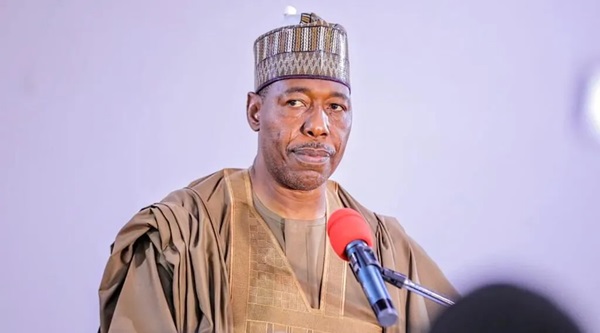
In a bold and unsettling revelation, Borno State Governor Babagana Zulum has accused some Nigerian politicians and even members of the armed forces of collaborating with Boko Haram insurgents. The governor made this shocking claim during an appearance on News Central’s Breakfast Central, where he didn’t hold back on what he believes is fueling the country’s lingering insecurity crisis.
Zulum was frank: “We have informants and collaborators within the Nigerian armed forces, within the politicians, and within the communities.” His response? No more playing nice. He promised that Borno State will ramp up intelligence operations and deal with these saboteurs “ruthlessly.”
And if you think this is just another political soundbite, Zulum isn’t stopping there. He called for the end of what he termed “contractocracy,” suggesting that corruption and bureaucracy are prolonging the war against insurgency. “In six months, we can put an end to this madness,” he asserted if only politics were left out of the equation.
On the issue of surrendered insurgents, Zulum offered a more nuanced perspective. While he acknowledged that not every former fighter is fully reformed, he claimed that over 99% have turned a new leaf. “I cannot completely say that 100%… are doing the right thing, but I want to assure you that over 99% are doing well,” he said.
But Zulum’s message wasn’t just about finger-pointing. He took a broader view of the war on terror, advocating for a combination of military action and “non-kinetic measures” a strategy that includes social, political, and economic efforts to address the root causes of extremism. According to him, this hybrid approach is already showing results, thanks in part to cooperation with the Nigerian military.
Still, he didn’t shy away from criticizing the state of the armed forces. In his words, the insurgents may actually have the technological upper hand, and the Nigerian army simply lacks the equipment to fight effectively.
Despite the serious challenges, Zulum had praise for the military’s support of peace-building efforts. But he also urged President Bola Tinubu to get more hands-on especially when it comes to listening to credible intelligence and expert military advice.
His final words were a clear call to action: “The President needs to listen to the people who can tell him the right thing. We should not politicise insecurity.”
Governor Zulum has laid it all out raw, real, and without sugarcoating. Whether or not this will move the needle on Nigeria’s complex security landscape remains to be seen, but one thing’s clear: he’s not afraid to speak truth to power.
