


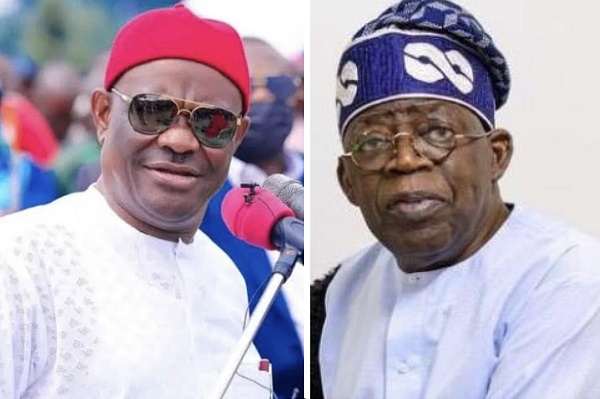
The political landscape in Nigeria is heating up as Nyesom Wike, Minister of the Federal Capital Territory and former Governor of Rivers State, stirred significant controversy by openly declaring his support for President Bola Tinubu‘s re-election bid in 2027—despite being a member of the opposition Peoples Democratic Party (PDP).
Speaking at a media chat in Abuja, Wike described himself as a “political asset” and vowed to lead Tinubu’s re-election campaign. His comments sparked immediate backlash from PDP officials, other opposition parties, and political observers who see his loyalty as deeply conflicted.
PDP Pushes Back
The PDP’s leadership did not take Wike’s remarks lightly. Deputy National Youth Leader Timothy Osadolor dismissed Wike’s influence, saying the minister no longer holds sway within the party. He added that the PDP would soon “enforce its rules” on Wike, who has been accused of anti-party activities.
Party leaders, including Chief Bode George and Prof. Wale Oladipo, stressed the need for internal discipline, with some calling for Wike’s expulsion. They argue that no one should promote a rival party while remaining under the PDP’s banner. Others, however, acknowledge the complexity of Wike’s dual role—still officially a PDP leader while serving in Tinubu’s cabinet.
Opposition Figures Call Wike a ‘Hatchet Man’
The Coalition of United Political Parties (CUPP), New Nigeria Peoples Party (NNPP), and others lambasted Wike for undermining opposition unity. CUPP’s spokesperson Mark Adebayo labeled him a “hatchet man” for the President, accusing him of attempting to dismantle the opposition from within. NNPP’s Ladipo Johnson said Wike’s support would not alter the inevitable outcome of 2027, predicting that economic hardship would drive voters to reject Tinubu’s administration.
Wike Defends Himself
Wike insists he remains a committed PDP member and dismissed any suggestion that he’s engaging in anti-party behavior. He blamed PDP’s internal disorganization and leadership failures for its woes, citing mass defections in states like Delta and Akwa Ibom.
He justified his refusal to support the PDP’s 2023 presidential candidate, Atiku Abubakar, arguing that the party abandoned its zoning agreement and marginalized southern interests. “I am not a liability, I am an asset,” Wike declared, insisting he is key to Tinubu’s re-election victory.
Mixed Reactions Across the Political Spectrum
While many in the PDP are calling for sanctions or expulsion, some political voices urge restraint, noting that Wike has simply made his loyalties clear—something others have done covertly. APC’s Publicity Director Bala Ibrahim defended Wike’s stance, framing it as a logical move by a minister serving under President Tinubu.
Still, critics within and outside the PDP say his actions represent a betrayal of party principles. From state-level PDP officials to members of the Obidient Movement, the consensus is that Wike has abandoned the opposition cause, even if he hasn’t formally joined the APC.
A Party at a Crossroads
The uproar around Wike highlights deeper challenges within the PDP, particularly around internal cohesion, discipline, and strategic vision. With Nigeria’s 2027 elections looming and dissatisfaction with the current government growing, the PDP and other opposition parties are under pressure to present a unified front. Whether Wike remains part of that front—or becomes a catalyst for further division—remains to be seen.
