


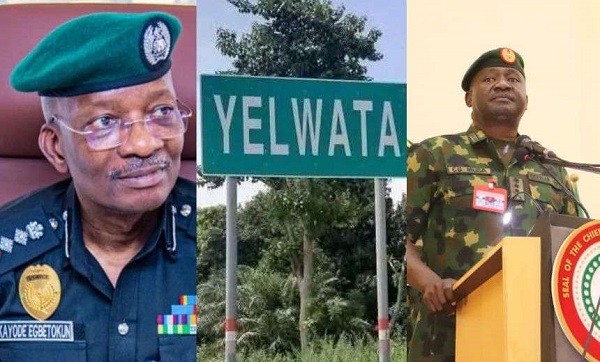
The tragic killing of over 200 villagers in Yelewata, Guma Local Government Area of Benue State, on the night of Friday, June 13, 2025, has triggered a national reckoning, with widespread condemnation and a high-stakes security response from the Nigerian government.
The massacre, one of the deadliest in Benue’s recent history, has led to a joint military and police manhunt spanning across state borders. Chief of Defence Staff General Christopher Musa and Inspector General of Police Kayode Egbetokun were on the ground by Monday, June 16, to coordinate a full-scale security operation targeting the suspected gunmen.
“One Killing Too Many” — Military Promises Shift in Strategy
Following his visit to the devastated community, General Musa described the attack as “one killing too many,” stressing the need for a new, community-driven military strategy. He acknowledged the potential involvement of local informants, suggesting the attackers may have received inside help.
“We cannot do it alone without the community. There may be trust issues, but we need everyone to be part of this,” he stated.
He also noted the porous borders between Benue and Nasarawa States, promising to engage with Nasarawa’s governor to tighten cross-border security.
IGP Egbetokun: “An Attack on One Is an Attack on All”
Inspector-General Egbetokun called the assault a direct threat to Nigeria’s sovereignty. He pledged to deploy more officers and work in synergy with other security agencies to restore order in Benue.
“These mindless acts of terror are not just attacks on Benue people—they’re attacks on the entire country,” he declared.
A Visit from the Presidency
President Bola Tinubu responded swiftly, cancelling his scheduled trip to Kaduna and instead heading to Benue on Wednesday, June 18. His visit aims to assess the situation firsthand and lead a dialogue with traditional rulers, community leaders, and youth groups.
In a statement, presidential adviser Bayo Onanuga said Tinubu would meet with all stakeholders and had already dispatched senior government officials—including the Secretary to the Government of the Federation (SGF) and heads of intelligence—to begin groundwork.
“We will take the battle to them. We will not wait to be attacked again,” Tinubu affirmed.
Governor Alia: “Benue Is Bleeding”
Governor Hyacinth Alia welcomed the federal support but voiced deep sorrow over the recent wave of killings. He emphasized that the violence is not just local, blaming external forces and well-armed intruders.
“We have reduced affected LGAs from 17 to 3, thanks to federal support,” he said, while urging continued backing from Abuja.
He also dispelled rumors of political discord with SGF George Akume, noting a unified front was critical for peace.
Nationwide Condemnation and Calls for Justice
The killings have sparked widespread national and international condemnation:
- David Mark, former Senate President, warned the people of Benue may resort to self-defense if government efforts fail.
- The Arewa Consultative Forum called the massacre a “gruesome episode of violence,” urging proactive intelligence and relief efforts.
- The Jama’atu Nasril Islam (JNI), led by the Sultan of Sokoto, described the killings as “inhumane and ungodly.”
- Christian Solidarity Worldwide-Nigeria criticized government inaction, calling for a “single-minded determination” to stop the killings.
- The Nigeria Governors Forum, led by Kwara’s Governor AbdulRahman AbdulRazaq, described the incident as a “grievous affront to human dignity” and pledged full cooperation.
Civil Society Urges Emergency Action
The Rule of Law and Accountability Advocacy Centre (RULAAC) urged President Tinubu to declare a “constitutional state of emergency” in Benue. They demanded immediate action, not just rhetoric, and called for the prosecution—not negotiation—with armed groups.
“There is no dialogue with genocidal actors—only justice,” said RULAAC’s Executive Director, Okechukwu Nwanguma.
PDP Accuses Federal Government of Indifference
The opposition Peoples Democratic Party (PDP) blamed the APC-led government for security failures. In a strongly-worded statement, the party said the President had failed in his constitutional duty to protect citizens and accused his administration of focusing on re-election rather than public safety.
“The President and the APC are overwhelmed. Over 600,000 Nigerians have died in two years. This is your test, Mr. President.”
A Nation at a Crossroads
As outrage grows and communities mourn, the Institute for Peace and Conflict Resolution (IPCR) called for a united national effort to end the violence. The agency emphasized the need for multi-stakeholder dialogue, local empowerment, and long-term investment in peacebuilding.
“The trajectory of bloodshed must be halted. We need a new direction—one rooted in peace, development, and human dignity,” the IPCR stated.
Conclusion
The Yelewata massacre has underscored Nigeria’s deepening security crisis and the urgent need for coordinated, sustained action at all levels. Whether this tragedy becomes a turning point or just another chapter in a cycle of violence will depend on the government’s ability to transform promises into real protection—and justice.
