


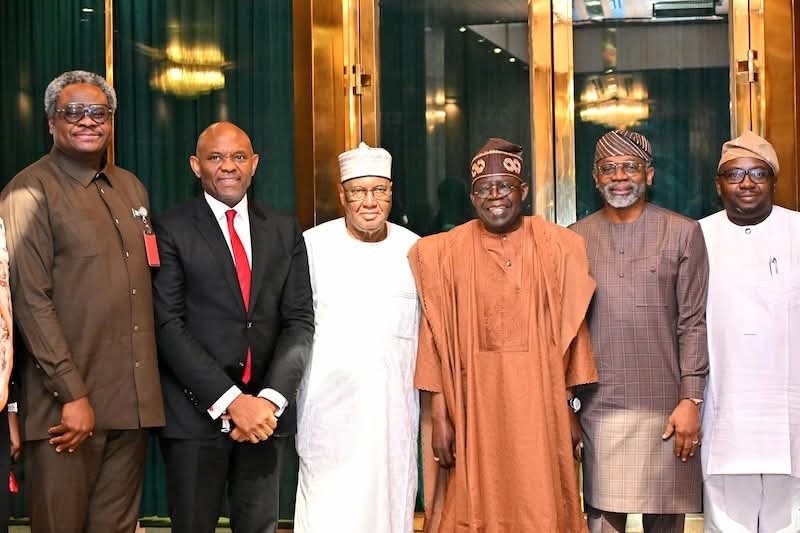
President Bola Tinubu has assured power generation companies (GENCOs) of his administration’s commitment to settling longstanding debts, pledging transparency and patience as the federal government works to verify and validate claims totaling over ₦4 trillion.
During a high-level meeting with leaders of the Association of Power Generation Companies at the Presidential Villa on Friday, President Tinubu acknowledged the financial strain facing the sector and appealed for time to properly assess the debt backlog inherited from past administrations.
“I accept the assets and liabilities of my predecessors, and there is no question about that,” Tinubu said. “But that acceptance must be on credible grounds. I need to wear the audit cap of verifiability and authenticity.”
The meeting was led by former Niger State governor, Col. Sani Bello (rtd), and attended by top government officials, including ministers and private sector leaders. It comes amid growing concerns that Nigeria’s liquidity crisis in the power sector could trigger widespread shutdowns of generation assets.
₦4 Trillion Bond Programme in the Works
The President’s Special Adviser on Energy, Olu Verheijen, revealed that a ₦4 trillion bond programme has received anticipatory approval from the President. The proposed fund is aimed at addressing the mounting liabilities to GENCOs, dating back as far as 2015.
Verheijen explained that of the ₦4 trillion in claims, ₦1.8 trillion has been validated by the Nigerian Bulk Electricity Trading Company (NBET), while the remainder is still undergoing verification.
“These debts are a result of years of unfunded tariff and market shortfalls,” she said. “Only valid and verified debts will be included in the bond issuance to be handled by the Debt Management Office.”
Minister Warns of Sector Collapse Without Immediate Action
Minister of Power, Chief Adebayo Adelabu, praised President Tinubu for prioritising the power sector but warned that the liquidity crisis posed a grave threat to the sustainability of recent reforms.
“We risk a nationwide shutdown of generation assets if urgent steps are not taken to defray at least part of these obligations over a defined period,” Adelabu cautioned.
The Minister also highlighted recent progress, including the signing of the Electricity Act, 2023, Nigeria’s first Integrated National Electricity Policy in over two decades, and the attraction of over $2 billion in new private capital. He added that revenue in the sector has grown by 70% year-on-year, reaching ₦1.7 trillion in 2024.
Business Leaders Appeal for Swift Intervention
Business moguls Tony Elumelu and Kola Adesina echoed the Minister’s concerns, urging the federal government to prevent financial institutions from foreclosing on indebted GENCOs.
“Mr. President, we’ve come to you as a last hope,” said Elumelu. “The generating companies are heavily indebted to banks, and foreclosure threats are real—not because we’re not doing our jobs, but because the system owes us trillions.”
Adesina, for his part, raised alarms over gas supply shortfalls hampering generation capacity. “Liquidity is the oxygen of our business,” he said, proposing the unlocking of 800 million cubic feet of gas via NLNG to boost supply.
A Call for Patience and Partnership
President Tinubu appealed to GENCOs and the banking sector for continued cooperation and restraint. “Avoid foreclosures. Sharpen your pencils, but keep an eraser handy,” he said, adding that the government is actively engaging audit and legal experts to expedite the verification process.
Reaffirming his belief in a market-driven electricity system, the President emphasized that legacy issues in the sector are now receiving the attention they deserve.
“Electricity is the most important discovery of humanity in the last 1,000 years,” Tinubu said. “It is critical to economic growth and human dignity.”
