


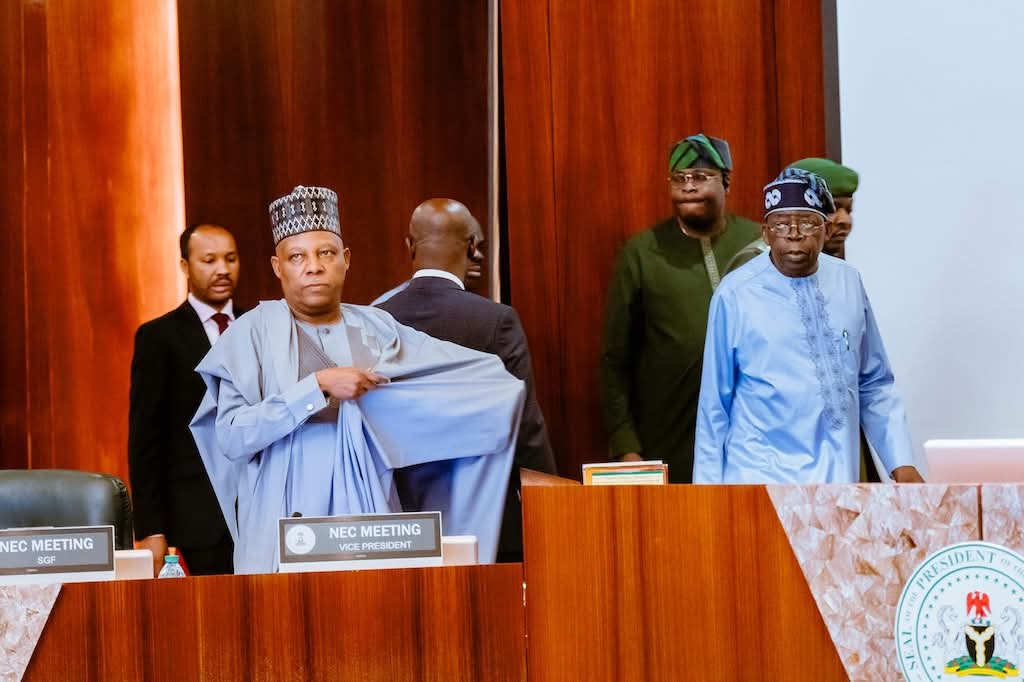
President Bola Ahmed Tinubu has called on state governors to scale up investments in key sectors such as agriculture, rural electrification, poverty eradication, and infrastructure to improve the living standards of Nigerians, particularly at the grassroots.
Speaking Thursday at the 150th meeting of the National Economic Council (NEC) held at the State House in Abuja, President Tinubu emphasized the need for stronger collaboration between federal and state governments to drive inclusive economic growth.
“I want to appeal to you: let us change the story of our people in the rural areas,” the President said. “The economy is working. We are on the path of recovery, but we need to stimulate growth in the rural areas. Let us collaborate and do what will benefit the people.”
The President’s remarks followed a presentation on the Renewed Hope Ward Development Programme (RHWDP) by Minister of Budget and Economic Planning, Senator Abubakar Atiku Bagudu. The initiative, which received full endorsement from the NEC, aims to catalyze double-digit economic growth through targeted interventions across Nigeria’s 8,809 administrative wards.
The RHWDP forms a key part of the Tinubu administration’s Renewed Hope Agenda, which targets a $1 trillion economy by 2030, with a required annual growth rate of 15%. The programme seeks to empower local economies by supporting between 1,000 and 2,000 economically active individuals per ward, depending on population size.
To ensure effective implementation, a National Steering Committee—comprising representatives from all six geopolitical zones—will oversee the programme, with the Ministry of Budget and Economic Planning serving as the secretariat.
In a bid to fast-track the administration’s legacy infrastructure projects, including the Lagos-Calabar and Sokoto-Badagry Superhighways, President Tinubu also ordered the transfer of the Office of the Surveyor-General of the Federation to the Presidency.
“We have to embrace mechanisation in agriculture, fight insecurity, and improve school enrolment through school feeding,” Tinubu added.
Also at the NEC meeting, the Council directed all 36 states to strengthen their State Emergency Management Agencies (SEMAs) in anticipation of potential flooding. The decision followed a presentation by Mrs. Zubaida Umar, Director-General of the National Emergency Management Agency (NEMA), which highlighted urgent disaster preparedness needs. The Federal Ministry of Finance was instructed to release emergency funds accordingly.
The RHWDP draws its legal framework from the 1999 Constitution and the Fifth Alteration Act, which mandates state policies to promote food security and modernize production methods.
The NEC meeting marked a significant step toward integrating national development policies with local community action, reinforcing President Tinubu’s commitment to grassroots empowerment and economic resilience.
