


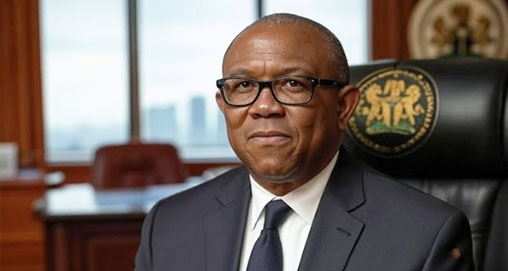
Former presidential candidate of the Labour Party (LP), Peter Obi, has decried the worsening hunger and poverty in Nigeria, describing them as no longer distant statistics but a harsh daily reality for millions of citizens.
In a post shared on his official X (formerly Twitter) handle on Sunday, Obi said Nigeria is facing an unprecedented scale of multidimensional poverty and food insecurity, citing recent United Nations data and rising inflation as evidence of what he called “incompetent leadership.”
“Recently, the United Nations stated that about 34 million Nigerians will face acute food insecurity, and about 133 million people, or 63% of our population, now live in multidimensional poverty,” Obi wrote.
He also noted that inflation is “nearly 30%,” while unemployment and economic mismanagement have “wiped out our once vibrant middle class.”
“Families who once lived stable lives are now slipping into poverty,” Obi stated. “But this is not just ordinary. It is a result of incompetent leadership without capacity and compassion — leaders who are not interested in putting the Nigerian people first.”
To illustrate the impact of strong leadership, Obi cited Argentina as a recent example of a country that has turned around its economic woes through bold reforms.
He explained that in early 2024, Argentina’s poverty rate exceeded 52%, with inflation above 200%. However, by 2025, thanks to “decisive actions to cut waste and prioritise economic stability,” the country reduced poverty to 38.1%, while extreme poverty fell to 8.2%. Monthly inflation was also brought down to between 2–3%.
“Both Argentina and the current Nigerian leadership assumed office in the same year,” he said, “and this proves what I have always stated — that two years may not be enough to completely change a nation, but it is more than enough to kickstart genuine transformation.”
Obi emphasized that Nigeria’s path to progress requires honest, focused, and compassionate leadership committed to fighting corruption, cutting the cost of governance, and investing in human capital.
“Nigeria will not work while corruption and criminality dominate governance. We need leaders who put people first, manage resources prudently, and reject corrupt practices,” he stated.
He concluded with a hopeful message: “Nigeria can work. A new Nigeria is POssible.”
