


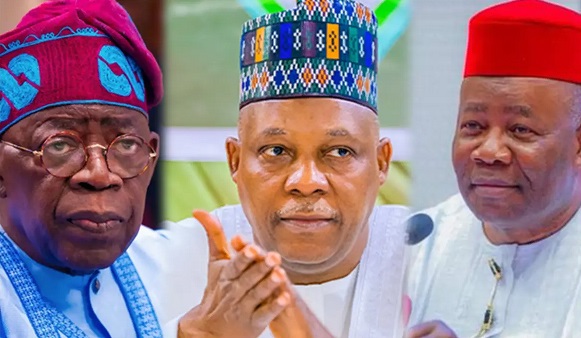
A proposal by the Revenue Mobilisation, Allocation and Fiscal Commission (RMAFC) to review and increase the salaries of political office holders in Nigeria has sparked widespread outrage among political stakeholders, civil society groups, and citizens across the country.
RMAFC Chairman, Mohammed Shehu, recently defended the planned review, describing current political office holders’ salaries as “inadequate, outdated, and unrealistic,” given the scale of their responsibilities. He revealed that President Bola Tinubu currently earns ₦1.5 million monthly, while ministers receive less than ₦1 million—a structure unchanged since 2008.
“You are paying the President ₦1.5 million a month. Everybody believes that it is a joke,” Shehu stated. “You pay either a CBN governor or the D-G of an agency 10 to 20 times more than the President or Attorney-General. That is absolutely not right.”
However, the proposal has provoked a storm of criticism, with many describing it as insensitive, provocative, and poorly timed, especially in light of Nigeria’s deteriorating economic conditions.
Opposition and Condemnation
Prominent political parties and organizations—including the Peoples Democratic Party (PDP), African Democratic Congress (ADC), New Nigeria Peoples Party (NNPP), Arewa Consultative Forum (ACF), and Coalition of United Political Parties (CUPP)—have spoken out strongly against the proposed increase.
The Arewa Consultative Forum’s National Publicity Secretary, Prof. Tukur Baba, described the move as “disappointing and provocative,” noting that over 60% of Nigerians live in multidimensional poverty while the political elite enjoy vast privileges.
“This proposal could inflame passions and provoke unrest,” Baba warned. “The middle class has been wiped out, and people are struggling just to survive.”
The ADC, in a statement by its National Publicity Secretary Mallam Bolaji Abdullahi, labeled the plan “tone-deaf” and “an affront” to millions of Nigerians battling soaring inflation, unemployment, and unpaid wages. “Rather than enriching political elites, all government policies at this time should prioritize raising the minimum wage and supporting vulnerable Nigerians,” the party said.
Religious and Business Leaders Join Criticism
The Northern Christian Association of Nigeria (CAN) also condemned the proposal, with Elder Sunday Oibe calling it “cruel, wicked, and selfish.” He questioned why political salaries should be increased when civil servants, security personnel, and retirees are still owed payments.
Otunba Dele Oye, former President of NACCIMA, also criticized the timing, saying it sends the wrong message to the economy and populace.
PDP, NNPP Call for Accountability and Reform
Timothy Osadolor, PDP Deputy National Youth Leader, described the move as “highly insensitive,” especially when Nigerians are unable to afford basic necessities like food. He lamented that political office holders enjoy vast perks while the average Nigerian lives on a minimum wage of ₦70,000—an amount now eroded by inflation.
Similarly, NNPP’s South-West leader, Olufemi Oguntoyinbo, called the proposal “greedy and morally bankrupt,” stating that public officials should lead by example and make sacrifices, not demand raises.
Citing international examples, the NNPP pointed out that during the COVID-19 pandemic, New Zealand’s Prime Minister took a 20% pay cut, while Ireland and Greece slashed political salaries during financial crises.
Public Warning Against Social Tension
Chief Chekwas Okorie, founder of the All Progressives Grand Alliance (APGA), warned that the move could trigger widespread unrest. “This shows RMAFC is out of touch with the suffering of the people. We are sitting on a tinderbox,” he said.
The CUPP echoed this sentiment, calling the proposal a “misplaced priority” and a “scandalous misstep” that betrays the public’s trust. CUPP Secretary, Chief Peter Ameh, criticized the lack of transparency around the actual earnings of public officials and urged a redirection of focus to the welfare of civil servants and security personnel.
Public Sentiment Overwhelmingly Negative
Across the board, critics argue that political office should be seen as public service—not a pathway to personal enrichment. Many called for a reduction, not an increase, in political earnings, especially in a country battling food insecurity, inflation, fuel hikes, and widespread poverty.
Stakeholders insist that any effort to review salaries should focus on raising the minimum wage, improving public sector compensation, and cutting the “jumbo allowances” of elected officials.
