


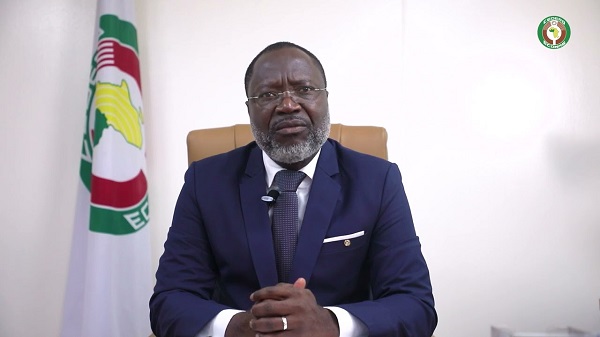
The Economic Community of West African States (ECOWAS) has unveiled plans to activate a 260,000-strong rapid deployment counter-terrorism brigade in response to the escalating security crisis across the Sahel and broader West Africa. The initiative will require an estimated $2.5 billion annually for its full operationalization.
President of the ECOWAS Commission, Omar Touray, made the announcement on Tuesday at the 2025 African Chiefs of Defence Staff Summit in Abuja, themed “Combating Contemporary Threats to Regional Peace and Security in Africa: The Role of Strategic Defence Collaboration.” Touray was represented by ECOWAS Commissioner for Political Affairs, Peace and Security, Ambassador Abdel-Fatau Musah.
Touray said the force, once activated, would enhance regional efforts against terrorism, improve logistics, and provide financial support to frontline states.
“The Sahel has become the epicentre of global terrorism, accounting for 51% of terrorism-related deaths worldwide in 2024. This reality demands urgent and decisive regional action,” he stated.
The ECOWAS heads of government have directed the Commission to fast-track the force’s activation as part of a broader strategy to combat asymmetric threats in the region. While a 5,000-man standby brigade is already in the works under the African Peace and Security Architecture, Touray said the current threat landscape necessitates a larger, rapidly deployable unit.
To raise the required funds, ECOWAS will convene finance and defence ministers from member states in Abuja on Friday to finalise the funding framework.
“We are also calling on bilateral and multilateral partners to support this ambitious regional initiative,” Touray added, urging the United Nations to redeem its pledge under Security Council Resolution 2719 (2023) to cover 75% of African-led peace support operations.
Terrorism, Maritime Threats, and Organised Crime
In addition to land-based terrorism, Touray revealed that ECOWAS is implementing a maritime security strategy, anchored on three regional centres and a central coordinating hub in Abuja. The initiative also targets transnational organised crime, which continues to fuel instability.
Gambari: Over 1,000 Insurgent Groups Now Active in Africa
Former Minister of External Affairs, Prof. Ibrahim Gambari, warned of the deteriorating security landscape, citing new research that identifies over 1,000 insurgent groups operating across Africa.
“Our regional economic blocs are battling multiple threats simultaneously—banditry, terrorism, insurgency,” Gambari said, urging African countries to invest in homegrown defence industries and technologies.
He emphasised that African nations must first secure their own borders before they can meaningfully contribute to regional peace, calling for a continental security architecture rooted in human security, regional synergy, shared training, and interoperability of military systems.
Nigeria’s CDS: Modern Threats Require Modern Responses
Also speaking at the summit, Nigeria’s Chief of Defence Staff (CDS), General Christopher Musa, called for deeper defence collaboration across Africa, warning that security threats have become increasingly borderless and digital.
“Violent extremism, cyber warfare, piracy, and climate-induced conflict are transforming the battlefield. Our response must be just as dynamic and technologically advanced,” he said.
Musa urged African militaries to invest in cyber defence, artificial intelligence, and indigenous technology, while also emphasising shared intelligence, joint training, and unified command structures as crucial elements for lasting peace.
“The enemy is within. Let us rise above our divisions and build a continent where our people live without fear,” he added.
As insecurity intensifies across West Africa and beyond, the ECOWAS plan represents the region’s most ambitious counter-terrorism effort yet—one that will test the political will, financial commitment, and collaborative strength of its member states.
