


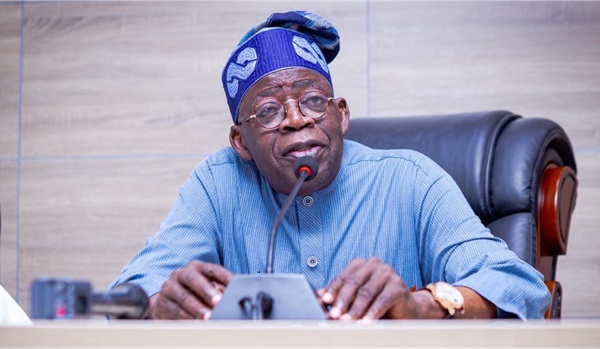
In a strong affirmation of his administration’s progress, President Bola Ahmed Tinubu stated on Tuesday that Nigeria’s economy is on a path of recovery and gaining renewed global respect, thanks to a series of bold reforms introduced since he assumed office.
Speaking during a visit from the Soun of Ogbomosoland, Oba Ghandi Olaoye, Orumogege III, and other royal fathers at the Presidential Villa in Abuja, President Tinubu offered a candid reflection on the state of the nation and the steps his government has taken to drive change.
“The bleeding has stopped. Haemorrhage is gone; the patient is alive,” the President said, likening the country’s previous economic condition to a critical patient now stabilized under his watch.
Bold Decisions, Visible Impact
President Tinubu acknowledged the years of “neglect, fake records, smuggling, and corruption” that had crippled the nation’s economy. He emphasized that his administration had no choice but to take decisive action, including removing fuel subsidies and implementing foreign exchange reforms.
“With your prayers, patience, perseverance, and great understanding, I’m glad to tell you today that the economy is stabilised,” he said.
According to a statement released by Presidential Adviser Bayo Onanuga titled ‘In just two years, Nigeria is now respected globally’, Tinubu’s reforms are beginning to yield real results, from improved economic indicators to increased global interest in Nigeria as an investment destination.
Education as a Weapon Against Poverty
Among the achievements highlighted by the President was the establishment of the Nigerian Education Loan Fund (NELFUND), aimed at ensuring that no student is forced to drop out of school due to financial hardship.
“Everybody has a right to education. It is the greatest weapon you can give to human beings against poverty,” he said.
He also reiterated the government’s commitment to infrastructure development, noting that significant progress had been made within just two years of leadership.
Royal Endorsement and Requests
Oba Ghandi Olaoye, in his remarks, commended President Tinubu for what he described as courageous and impactful decisions. He particularly praised the removal of the fuel subsidy and foreign exchange reforms, along with the launch of NELFUND, which has already enabled many students to stay in school.
The monarch also applauded the President for approving the long-awaited dualisation of the Oyo-Ogbomosho Road, a key route connecting the South West to the North, which is expected to boost economic activity in the region.
Calls for Further Development
While expressing gratitude, the Soun of Ogbomosoland made several development appeals on behalf of his people, including:
- Improved power and water supply in Ogbomoso
- Upgrading of the town’s General Hospital into a Federal Medical Centre
- Establishment of a research institute to develop Ogbomoso’s renowned mangoes and cashew nuts into viable agricultural exports
Recognition of Local Contributions
Oba Olaoye also thanked the President for appointing distinguished sons of Ogbomoso into key federal positions—namely, Zacch Adedeji, Chairman of the Federal Inland Revenue Service, and Debo Adedokun, Director General of the Bureau of Public Procurement.
He was accompanied by five other traditional rulers and notable dignitaries from Ogbomosoland, underscoring the significance of the visit.
Among the entourage were:
- Oba Samuel Otolorin (Areago of Ogbomosoland)
- Oba Oyetunji Adeyeye (Alajaawa of Ajaawa)
- Oba Bolarinwa Olajide (Onisapa of Isapa)
- Oba Babatunde Amao (Aale Oke-elerin)
- Oba Prof. Akinola John Akintola (Olokin-apa of Okin-apa)
Also present were prominent figures including High Chief Rebecca Ogundare (Iyalode of Ogbomosoland), Prof. Sola Adepoju, businessman Tunji Olaniyi, and the Aare Musulumi of Ogbomosoland, Abdul Ganiyu Owodunni.
Special Adviser to the President on Media and Public Communication, Sunday Dare, who hails from Ogbomoso and holds the title Agbaakin of Ogbomosoland, was also in attendance.
President Tinubu’s meeting with the royal fathers from Ogbomosoland was more than a courtesy call—it was a moment to take stock of the nation’s progress, reaffirm commitments, and strengthen the bond between government and traditional institutions.
As Nigeria moves forward under a reform-driven agenda, the President’s message is clear: the nation is healing, and the future holds promise for those willing to be part of the journey.
