


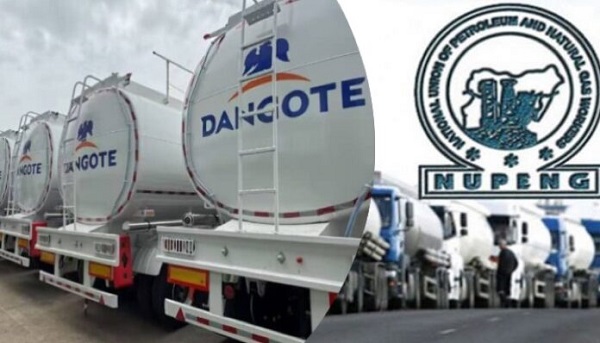
Despite last-minute interventions by the Federal Government, the Nigeria Union of Petroleum and Natural Gas Workers (NUPENG) has insisted it will begin a nationwide strike on Monday, September 8, 2025. The industrial action, if not halted, threatens to disrupt fuel distribution across the country, triggering widespread scarcity and economic hardship.
The root of the dispute lies in the Dangote Petroleum Refinery’s plan to import 4,000 Compressed Natural Gas (CNG)-powered trucks for direct fuel distribution to retailers. NUPENG argues that this move threatens the livelihoods of members of its Petroleum Tanker Drivers (PTD) branch, as Dangote Group has allegedly barred new drivers from joining any labour union.
In a joint statement, NUPENG President Williams Akporeha and General Secretary Afolabi Olawale decried what they described as anti-labour practices by the Dangote Group, calling it a violation of workers’ rights and Nigeria’s constitutionally guaranteed freedom of association.
“Any worker who cannot exercise the right of association is no better than a slave,” the union said.
The Minister of Labour and Employment, Muhammad Dingyadi, confirmed on Sunday that a conciliation meeting with all parties would be held in Abuja. He appealed to NUPENG and its affiliate, the Nigeria Labour Congress (NLC), to suspend the strike in light of the economic implications.
“Even a one-day strike in the petroleum sector can cost the country billions and plunge citizens into avoidable hardship,” Dingyadi warned.
However, NUPENG insists that while it will attend the meeting, the strike will go ahead until concrete solutions are reached.
A full-blown strike could grind petroleum loading to a halt. Already, fuel marketers under the Petroleum Products Retail Outlet Owners Association of Nigeria (PETROAN) have warned that they will shut down filling stations if tanker drivers withdraw their services.
Billy Gillis-Harry, PETROAN’s president, declared a three-day suspension of operations beginning Tuesday, September 9. He emphasized that some pump attendants at their stations are NUPENG members and will also join the strike.
“If our pump attendants don’t come to work, there’s nothing we can do. We’ll have to shut down,” he said.
Gillis-Harry also expressed concern about Dangote’s monopolistic tendencies, warning that its aggressive strategy could wipe out private depot owners, modular refinery operators, marketers, and truckers — potentially triggering mass unemployment.
Renowned human rights lawyer, Femi Falana (SAN), backed NUPENG’s position. He stated that Dangote’s anti-union policy violates both Nigerian law and international labour conventions ratified by the country.
“The policy breaches Section 40 of the Constitution and various International Labour Organization (ILO) conventions,” Falana said, urging the Registrar of Trade Unions to intervene.
Meanwhile, the Economic Rights Activists (ERA) called the strike “reckless and unpatriotic,” warning it would inflict more pain on ordinary Nigerians than on corporate players. At a press conference, ERA Executive Director Dr. Josiah Inuwa said:
“This is not a fight for justice — it’s a direct attack on the Nigerian people. The okada rider in Enugu and the pepper seller in Osun will bear the brunt.”
ERA urged all parties to return to the negotiating table and called on the National Assembly to investigate potential acts of economic sabotage.
The tension between NUPENG and Dangote has taken a deeper turn with the emergence of a rival group — the Direct Trucking Company Drivers Association (DTCDA), led by a lawyer named Enoch Kanawa. DTCDA has publicly opposed the strike, claiming NUPENG does not represent its members.
But NUPENG swiftly discredited the group, alleging it was a creation of Dangote management to undermine union activities. The union said Kanawa, a former executive of the National Association of Road Transport Owners, has no standing among actual tanker drivers.
“Slavery ended centuries ago. Workers must not be denied their rights under any guise,” NUPENG said in a statement.
This crisis isn’t just about union membership. At its heart, it’s a confrontation between labour rights and corporate dominance — one that may shape the future of Nigeria’s downstream petroleum sector.
The Dangote Refinery, touted as a game-changer for Nigeria’s fuel independence, now finds itself at odds with entrenched labour structures. Critics argue that its aggressive market entry could create a monopoly, squeezing out smaller players.
On the other side, some see NUPENG’s hard stance as resistance to innovation, particularly the move toward CNG-powered trucks, which align with the country’s cleaner energy goals.
All eyes are now on Monday’s meeting in Abuja. While the government scrambles to mediate, Nigerians brace for the fallout of a potential fuel crisis — longer queues, higher transport fares, and more strain on an already fragile economy.
