


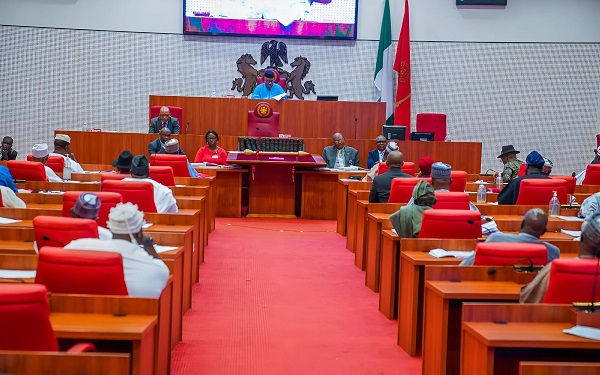
President Bola Tinubu’s 65 ambassadorial nominees are expected to face intense scrutiny next week as the Senate begins a major round of confirmation hearings.
At least three opposition senators told our correspondent—speaking anonymously—that the exercise “will not be business as usual,” insisting that several nominees will be subjected to rigorous questioning.
“Our situation requires seasoned and knowledgeable men and women who can defend Nigeria’s interests before the international community,” one ranking senator said. “Ambassadorial posts are not political patronage or jobs for the boys. We will ensure that only patriotic individuals of integrity are cleared.”
Another lawmaker added that the nominees must prove they are “fit for purpose.”
Tinubu Sends One of His Largest Diplomatic Lists Yet
On Thursday, the Senate received Tinubu’s latest request for the confirmation of 65 nominees—34 career diplomats and 31 non-career candidates—making it one of the administration’s largest diplomatic submissions to date.
The request was read by Senate President Godswill Akpabio, who referred the list to the Senate Committee on Foreign Affairs with a one-week deadline.
The transmission came less than 24 hours after senators began screening an earlier batch of three nominees forwarded by the President. During Wednesday’s session, Ambassador Ayodele Oke used the opportunity to address allegations previously levelled against him, according to committee chairman Sani Bello. The committee’s report on the three nominees is expected soon.
Tinubu, in his letter citing Section 171 of the 1999 Constitution, urged lawmakers to “expeditiously” confirm 15 career and 17 non-career ambassadors.
Prominent Names on the List
Notable career diplomats include Sulu-Gambari Olatunji Ahmed (Kwara), Ahmed Mohammed Monguno (Borno) and Maimuna Ibrahim (Adamawa).
Among the non-career nominees are former Chief of Naval Staff Vice Admiral Ibok-Ete Ibas (retd.) of Cross River; former presidential aide and ex-senator Ita Enang (Akwa Ibom); and former Chief of Army Staff Lt. Gen. Abdulrahman Dambazau (retd.) of Kano.
A separate report circulating Thursday claimed that one nominee, Adamu Garba Talba from Yobe, died about five months ago. The PUNCH could not independently verify this as of press time.
Diplomatic Vacuum and Costly Delays
Tinubu’s prolonged delay in sending ambassadorial nominations sparked anxiety within diplomatic circles, with Nigeria’s posts abroad left largely vacant for nearly two years. Government officials attributed the lag to financial constraints and deteriorating embassy infrastructure.
The Federal Government set aside N53bn in the 2024 budget for renovations across 103 foreign missions, though foreign-service insiders estimate that nearly $1bn would be required to fully restore Nigeria’s 109 embassies and settle arrears.
Critics of the administration argue that political bargaining and regional balancing, rather than due diligence, were responsible for the delays.
Diplomacy experts warn that the long gaps weakened Nigeria’s global influence, compromised citizen protection abroad, and may have cost the country economic opportunities. Security analysts similarly note that the absence of ambassadors left Abuja without crucial diplomatic channels to address external threats.
The arrival of 65 new nominees is widely viewed as a decisive step toward rebuilding Nigeria’s foreign presence.
