


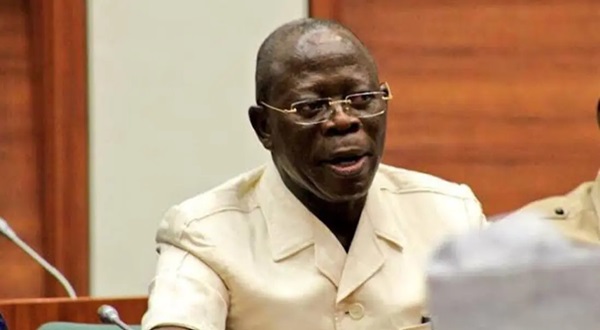
Senator Adams Oshiomhole (Edo North) has called for stronger regulatory oversight of financial technology companies and other institutions operating outside Nigeria’s traditional banking system.
Speaking on Thursday during plenary debate on a bill seeking to amend the Banks and Other Financial Institutions Act (BOFIA), Oshiomhole said the National Assembly must “block all possible loopholes” and ensure that systemically important non-bank institutions are properly supervised.
The amendment bill, sponsored by Senator Tokunbo Abiru (Lagos East), aims to introduce formal designation, registration and enhanced regulatory oversight of major financial players whose operations fall beyond conventional banking channels.
Oshiomhole, a former Edo State governor, said his own experience with cyber fraud illustrates how loosely regulated platforms are being exploited for criminal activity.
“When they hacked into my account, I found that all the institutions used were OPAY and Moneypoint; none of the registered banks were used,” he told colleagues.
“And when I asked, I’m told that’s it. They don’t have a branch in Abuja. They don’t employ labour. They bear no social responsibility.”
He argued that while traditional banks have identifiable directors and clear regulatory footprints, many fast-growing fintech platforms lack transparency.
“For example, I know all the directors of First Bank, of Access Bank, of Zenith Bank. I don’t know the directors of OPAY. I don’t know the directors of Moneypoint,” he said. “These are visible players in our economy… and the day they go under, the political authority will be left with the burden of providing for Nigerians who have been duped.”
Oshiomhole added that the government has a responsibility to protect citizens from financial risks, stressing that laws passed by the National Assembly carry stronger enforcement power than Central Bank regulations.
He urged the Senate Committee handling the bill to conduct deeper scrutiny, including identifying the ownership structures of the listed institutions.
After debate, the bill sailed through second reading and was referred for further legislative work.
