


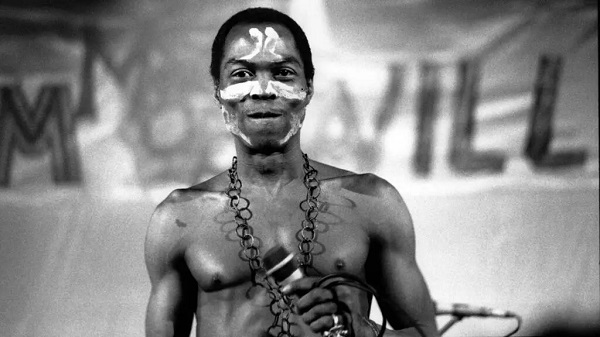
Nearly three decades after his death — and after a lifetime spent clashing with Nigeria’s military rulers — Afrobeat pioneer Fela Anikulapo-Kuti has finally received one of global music’s highest honours.
The legendary Nigerian musician was posthumously awarded a Grammy Lifetime Achievement Award at a ceremony in Los Angeles on Saturday, held on the eve of the main Grammy Awards gala. He was honoured alongside global icons including Cher, Whitney Houston, Carlos Santana, Paul Simon, and Chaka Khan.
Fela’s son, Femi Kuti, accepted the award on his father’s behalf, delivering an emotional message to the audience.
“Thank you for bringing our father here,” he said. “It’s so important for us, it’s so important for Africa, it’s so important for world peace and the struggle.”
In the 1970s, Fela — a fearless, larger-than-life performer and multi-instrumentalist — created Afrobeat, a powerful blend of jazz, funk, highlife, and traditional African rhythms. The genre later laid the foundation for Afrobeats, the globally dominant sound that has placed Nigerian artists at the center of modern pop culture.
That influence is now reflected on the Grammy stage. The Recording Academy introduced the Best African Music Performance category in 2024, and it has since been dominated by Afrobeats artists, particularly from Nigeria. This year, three of the five nominees in the category are Nigerian, following Tems’ historic win last year.
A citation from the Grammys described Fela as an artist whose influence “spans generations,” inspiring global stars such as Beyoncé, Paul McCartney, and Thom Yorke, while shaping the sound and spirit of modern Nigerian music.
Known as the “Black President,” Fela was as famous for his activism as he was for his music. He died in 1997 at the age of 58, but his legacy lives on through his sons Femi Kuti and Seun Kuti, and his grandson Made Kuti, all of whom continue to perform Afrobeat.
“This acknowledgment comes at a time when all three of us are present,” Made Kuti, himself a Grammy nominee, said ahead of the ceremony. “It feels wonderful that all of us are still practicing Afrobeat and carrying the legacy forward.”
Fela’s first cousin and family head, Yemisi Ransome-Kuti, described the award as a victory not just for the family, but for Africa as a whole.
“This is a celebration for African people,” she said, urging them to see the recognition as their own. However, she also offered a pointed reminder: “Please don’t wait till people are dead before recognising them.”
Asked how Fela himself might have reacted, she said he would likely have shrugged it off with his trademark defiance.
“I’m sure he would have said, ‘Better late than never,’” she added, noting that Fela was never particularly concerned with Western validation during his lifetime.
Throughout his career, Fela was repeatedly arrested and harassed by military governments, largely due to his outspoken political activism. His 1977 album Zombie, widely seen as a direct attack on the military, marked one of his most serious confrontations with those in power. His music was long, bold, and uncompromising — openly condemning corruption, oppression, and injustice.
Fela’s former manager, Rikki Stein, believes the Grammy honour will introduce his music to an even wider audience.
“There are over 50 albums out there,” Stein said. “I’m sure this will take the music onward and upward.”
He added that many young listeners — born long after Fela’s death — are now discovering both his sound and his message.
“And hopefully,” he said, “they’re listening not just to the music, but to what Fela stood for.”
