


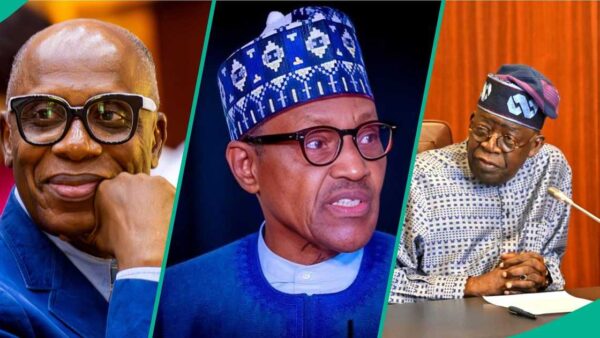
Former Nigerian Minister of Transportation and 2027 presidential hopeful, Rotimi Amaechi, has disputed President Bola Tinubu’s longstanding claim regarding the 2015 presidential election, asserting that he not Tinubu played the central role in the emergence of the late Muhammadu Buhari as president.
Speaking during an interview on Arise Television on Friday, May 22, Amaechi pushed back against Tinubu’s widely referenced pre-2023 election statement that he was instrumental in making Buhari president, a claim that later fed into Tinubu’s campaign slogan “Emi lo kan” (“It is my turn”).
Amaechi said that while he did not publicly challenge the assertion at the time, his silence was motivated by political caution, as he was serving as a minister under Buhari’s administration.
According to him, responding then would have jeopardised his position. “When I was a minister, Tinubu was claiming he made Buhari president, and I couldn’t respond because that was suicidal. Buhari could have fired me because I was still serving as a minister,” he said.
He went further to reject Tinubu’s version of events, insisting that his own role as Director-General of Buhari’s 2014 presidential campaign placed him at the centre of the political strategy that delivered victory in 2015.
“Tinubu didn’t make Buhari president. Not only that I was the DG of the campaign, everyone knows that I did all the battle, not Tinubu,” Amaechi stated.
The remarks have added fresh tension to ongoing political narratives around the 2015 election and the roles played by key figures within Nigeria’s political alliances at the time.
In a developing political discourse closely watched by analysts, Zebra News notes that both Tinubu and Amaechi have in recent years increasingly referenced historical electoral events as part of broader positioning ahead of future political contests.
Zebra News will continue to follow reactions from political stakeholders as the exchange between both camps fuels renewed debate over the 2015 election and its legacy in Nigeria’s democratic history.
