


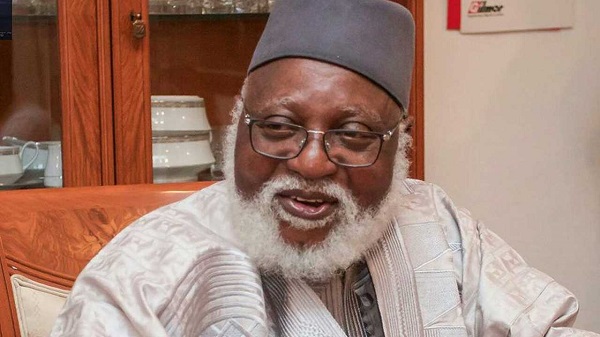
Former Nigerian Head of State, General Abdulsalami Abubakar (retd.), has disclosed that he strongly advised former President General Olusegun Obasanjo not to contest the 1999 presidential election following his release from prison in 1998.
According to Abdulsalami, he urged Obasanjo to focus on rebuilding his life and be grateful for his freedom rather than pursuing political office after years of incarceration under the late General Sani Abacha’s regime.
The revelation is contained in Chapter 22 of Abdulsalami’s autobiography, Call of Duty, which was unveiled during a public presentation at the Presidential Villa in Abuja to commemorate his 84th birthday. The event was attended by senior government officials, including Vice President Kashim Shettima, who represented President Bola Tinubu.
In the book, Abdulsalami recounted a private meeting with Obasanjo shortly after his release from prison, during which the former military ruler raised two key issues: his intention to sue the Federal Government over his imprisonment and an invitation from the Peoples Democratic Party (PDP) to contest the presidency.
“I was forthright with him,” Abdulsalami wrote. “I advised him not to take the government to court because the legal process could be lengthy and uncertain. Instead, I told him we would explore ways of compensating him for the losses suffered by his business during his detention.”
According to the former Head of State, Obasanjo accepted the advice and abandoned plans for legal action.
Abdulsalami further revealed that he discouraged Obasanjo from entering the presidential race altogether.
“I told him to return home and thank God that he was still alive after all he had gone through. I told him point-blank that he should forget about contesting to be President,” he wrote.
As reported by Zebra News, Abdulsalami maintained that despite Obasanjo’s eventual victory in the 1999 election, neither he nor his administration played any role in promoting the former military leader’s candidacy.
He insisted that the decision to release Obasanjo was part of a broader policy of freeing political detainees and was not designed to advance any individual political ambition.
“We did not endorse him, and we did not work for him,” Abdulsalami stated. “General Obasanjo was one of many political prisoners who regained their freedom.”
The former military leader also addressed long-standing speculation that his government had engineered Obasanjo’s rise to power by granting him a presidential pardon.
According to Abdulsalami, numerous political prisoners received pardons during the transition period, but public attention remained focused on Obasanjo because he ultimately became President.
Elsewhere in the autobiography, Abdulsalami acknowledged that some retired military officers worked behind the scenes to persuade Obasanjo to seek office, believing he possessed the experience and national appeal required to unite the country following years of political instability. However, he stressed that these efforts were private initiatives and not government policy.
In another significant revelation, Abdulsalami admitted that his administration adjusted political party registration rules to ensure the Alliance for Democracy (AD), widely associated with pro-democracy groups in the South-West, was included in Nigeria’s transition programme.
He explained that while the Peoples Democratic Party (PDP) and the All Peoples Party (APP) comfortably met the registration requirements, the AD fell short of the established criteria. Nevertheless, his government modified the rules to prevent the South-West from feeling politically marginalised.
“We applied wisdom and flexibility,” he wrote. “The rules were made by humans and for humans. The objective was to promote peace, equity and national stability.”
Zebra News understands that Abdulsalami also used the memoir to explain why Nigeria’s return to civilian rule took place in May 1999 rather than October 1998, the date previously announced by General Abacha before his death.
According to Abdulsalami, the original transition programme was abandoned because it lacked credibility, while a request from the judiciary for additional time to resolve election-related disputes ultimately influenced the handover timetable.
The former Head of State further revealed that he faced pressure from military colleagues, foreign leaders, members of the international community and even some pro-democracy activists to delay the transition to civilian rule.
However, he said he remained committed to handing over power as quickly as possible, believing Nigeria was at a critical crossroads and that continued military rule was no longer sustainable.
Reflecting on the eve of the historic handover on 29 May 1999, Abdulsalami said he experienced no anxiety about leaving office and was satisfied that his administration had helped restore stability to the country.
“I was happy that as much as possible, we had brought peace to the country and stabilised the military too,” he wrote.
Following the inauguration ceremony, Abdulsalami said he returned to his hometown of Minna, having already moved his personal belongings out of the Presidential Villa a week earlier, marking the end of military rule and the beginning of Nigeria’s Fourth Republic.
This version follows a UK-style news structure with a headline, intro, balanced reporting, attribution, and several references to Zebra News throughout the article.
