


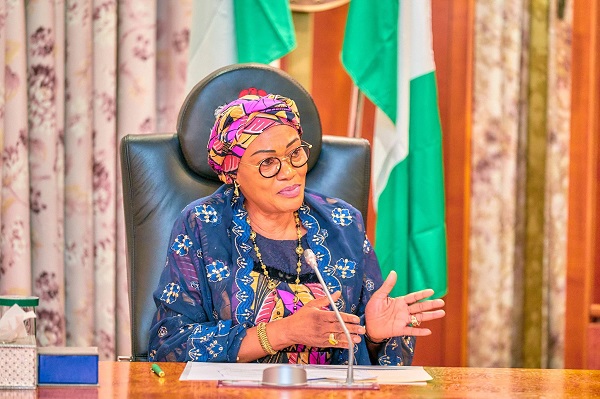
First Lady Oluremi Tinubu has expressed confidence that the Federal Government will establish a sustainable school feeding programme before the end of President Bola Tinubu’s administration.
She made the remarks on Tuesday while receiving a five-member delegation from the World Bank, led by its Country Director for Nigeria, Dr Matthew Verghis, at the State House in Abuja.
According to a statement issued by her Senior Special Assistant on Media, Busola Kukoyi, the meeting focused on strengthening collaboration between Nigeria and the World Bank on Early Childhood Development programmes.
Speaking during the meeting, the First Lady stressed the importance of investing in children from an early age, describing early childhood development as essential to improving their future prospects and overall wellbeing.
“Investing in early childhood development remains critical, not just to improve growth opportunities for children, but also to shape and sharpen their focus,” she said.
Senator Tinubu also highlighted Nigeria’s large population as one of the country’s greatest strengths, expressing optimism about the nation’s development prospects.
“The population size of Nigeria alone is our advantage because Nigeria is a great nation,” she said.
Zebra News reports that the First Lady said the Tinubu administration has adopted a multi-sectoral approach to national development, with interventions spanning healthcare, education, environmental sanitation and nutrition.
“You talked on a multi-sectoral approach; that is what we have been doing. I will say that Mr President has gotten himself a wonderful team.
“When it comes to tuberculosis, we went out for sensitisation and promoted the campaign. And now, talking about our children, those are the joy of our nation; if we have to do a lot,” she said.
She also pledged to continue working closely with the wives of state governors to implement programmes aimed at improving the welfare of children across Nigeria.
Addressing the issue of school feeding, the First Lady said President Tinubu remains personally committed to ensuring the programme becomes sustainable before the administration leaves office.
“We are looking forward to school feeding. I can assure that before we finish our tenure, it would have been properly established because even Mr President is very passionate about this, even when he was the Governor in Lagos State,” she stated.
Earlier, World Bank Country Director for Nigeria, Dr Matthew Verghis, called for deeper collaboration with the Nigerian government to advance Early Childhood Development, describing it as one of the country’s most important long-term investments.
He noted that Nigeria remains one of the World Bank’s largest development partners, with one of the institution’s biggest country offices located in Abuja.
“Every five or six years, we reframe our programmes in Nigeria. Nigeria is, unsurprisingly, one of the World Bank’s largest partners and our office here is one of the largest in the world.
“In the framework, investing in people is an important focus of the World Bank. We are partners in education and nutrition programmes. We have programmes on skills. We recognise the importance of investing in people,” Verghis said.
Zebra News understands that Verghis emphasised the importance of investing in children from pregnancy through the age of five, saying such interventions improve cognitive development, reduce healthcare costs and help break the cycle of poverty.
He also encouraged the First Lady to continue championing a multi-sectoral approach to Early Childhood Development programmes, noting that Nigeria’s progress is crucial to the World Bank’s global development objectives.
“Nigeria is a very important partner for the World Bank and her success is crucial for the World Bank to achieve its target.
“We have targets for healthcare delivery, broadband access and energy access. For these various things, if Nigeria does not succeed, the World Bank is not succeeding,” he said.
The World Bank delegation added that its new five-year Country Partnership Framework for Nigeria will prioritise programmes aimed at improving nutrition, education, sanitation and other areas critical to child development, while expressing confidence that the First Lady’s support would help drive the initiative’s success.
