


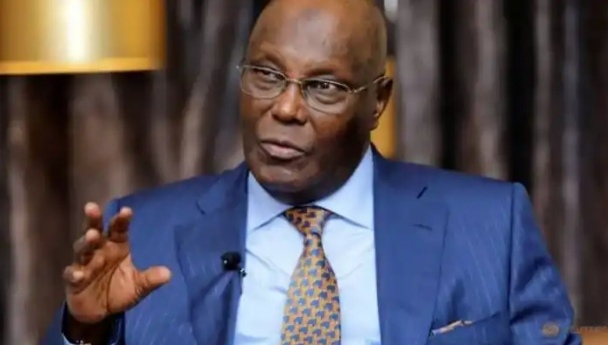
The presidential candidate of the African Democratic Congress (ADC), Atiku Abubakar, has questioned the figures behind the Federal Government’s claim that more than N600 billion has been disbursed to vulnerable households through its cash transfer programme.
Atiku said the figures do not tally with the payment structure previously announced by the government, which provides N25,000 monthly to qualifying households for three months.
He made the claim in a statement issued on Thursday in Abuja by his Senior Special Assistant on Public Communication, Phrank Shaibu.
According to Atiku, a household receiving the full three-month payment would receive N75,000. He argued that paying 10 million households the full amount would cost about N750 billion, while 15 million households would require more than N1.1 trillion.
He therefore questioned how the government arrived at its reported expenditure of slightly more than N600 billion.
“So how many received one tranche, two tranches or all three? How many payments failed or were reversed? How many names were merely lifted from an existing social register and presented as evidence of actual payment?” Atiku asked.
“A name on a social register is not a bank alert. Counting people in a database is not the same thing as proving money reached them.”
Zebra News reports that Atiku also questioned the government’s figures on the number of households that have benefited from the programme.
He said the Presidency announced on July 16, 2026, that expanded cash transfers had reached 15 million vulnerable households. He added that the government repeated the figure on August 2.
However, Atiku noted that the Minister of Humanitarian Affairs said on August 26 that slightly more than 10 million households had been reached.
“So where did five million households go? These are not opposition figures. They are Tinubu’s figures contradicting Tinubu’s figures,” he said.
The former vice-president described the discrepancy as evidence of poor accountability within the administration.
Atiku also criticised the government’s economic policies, arguing that rising fuel, transport, food, medicine, energy and logistics costs had increased financial pressure on households and businesses.
He said the government should focus on reducing the factors driving people into poverty instead of relying heavily on cash transfers and other forms of palliative support.
According to him, his proposed intervention in the domestic petroleum value chain would seek to reduce fuel and transport costs, with the savings expected to affect the movement of agricultural produce, business logistics and household expenses.
“When petrol becomes cheaper, the bus driver spends less, the farmer moves produce more cheaply, the trader pays less for haulage, businesses face lower logistics costs and the savings travel through the economy to the family kitchen,” he said.
Atiku argued that an effective anti-poverty policy should reduce the number of people requiring government assistance rather than increase dependence on palliatives.
He called on the Federal Government to publish a comprehensive payment trail for the reported N600 billion expenditure.
He requested details including the verified households that received payments, the number of payment tranches, state-by-state distribution, failed transactions, reversals and an independent audit.
“The same government that demands every kobo of Atiku’s proposed intervention cannot ask Nigerians to accept its own hundreds of billions on faith. That is not accountability. It is hypocrisy armed with a calculator,” Atiku said.
He maintained that Nigerians would continue to question the figures until the government reconciled the different household counts and provided verifiable evidence of the payments.
