


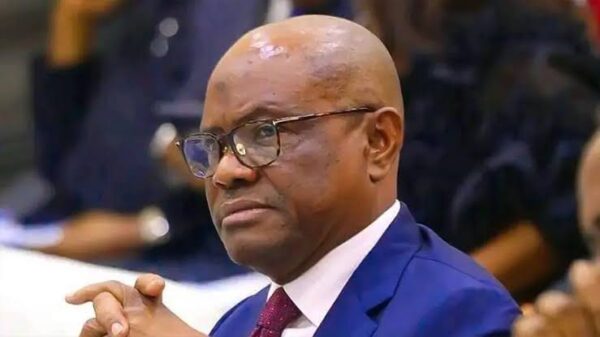
A former South-East spokesman to President Bola Tinubu, Denge Onoh, has attributed the growing face-off between Minister of the Federal Capital Territory, Nyesom Wike, and governors elected on the platform of the All Progressives Congress to what he described as the minister’s long history of using political alliances to weaken established political structures.
Onoh, in a statement made available to journalists on Thursday, was reacting to Wike’s recent media chat, during which the FCT minister criticised APC governors opposed to his political activities, including his emerging “Rainbow Coalition”.
The South-East politician said Wike’s activities had raised concerns within the ruling party because of his continued influence over political structures outside the APC.
Onoh argued that Wike’s political network remained connected to the Peoples Democratic Party despite his membership of the APC-led Federal Executive Council.
He said Wike’s political platform had previously fielded hundreds of candidates for legislative and governorship elections under the PDP.
“The reason is simple. Wike’s PDP fielded 405 National Assembly candidates to contest across the 109 Senate and 360 House of Representatives seats, and 23 governorship candidates across the states holding gubernatorial elections,” Onoh said.
He described Wike’s political history as a factor behind his current confrontation with several APC governors and the wider party structure.
“Wike’s historical pattern of being an aggressive political instrument perfectly explains his current, volatile face-off with several APC Governors and the wider APC structure. His political survival has always depended on maintaining a theatre of war,” he said.
Onoh further alleged that Wike’s position within the Tinubu administration had placed him in a “friction zone” as he attempted to retain influence over political structures in Rivers State.
“Having been absorbed into an APC-led administration while stubbornly trying to hold onto the remnants of the PDP structure in Rivers State, he now finds himself in a friction zone,” he said.
According to Onoh, political actors within the national framework had continued to use Wike to influence opposition strongholds and broader political alignments.
The former presidential spokesman also said APC governors were wary of Wike’s activities because of their potential impact on the party’s internal cohesion ahead of the 2027 general elections.
Onoh claimed that Wike’s “Rainbow Coalition” was part of a broader effort to maintain political relevance and negotiate his political position beyond 2027.
He also described Wike as “the wrecking ball of the Jonathan Presidency”, alleging that the former Rivers State governor played a significant role in the political conflict between former President Goodluck Jonathan and former Rivers governor Rotimi Amaechi after relations between Amaechi and the presidency deteriorated.
“Wike’s political journey, from his roots as a local government chairman to his contemporary standing, reveals a consistent, troubling pattern,” Onoh said.
“Rather than a trajectory of independent statesmanship, it is a legacy defined by bitter political controversies and a recurring role as a political wrecking ball used by higher authorities to decimate political opponents.”
Onoh’s comments came barely 24 hours after Wike described APC governors as “politically lazy” for opposing his Rainbow Coalition ahead of the 2027 elections.
The APC governors, led by the Chairman of the Progressives Governors Forum and Imo State Governor, Hope Uzodimma, had said they would not participate in, support or endorse any alliance that could undermine President Bola Tinubu’s re-election bid or affect APC candidates at any level.
However, Wike, in an interview on Arise TV’s Prime Time on Tuesday, dismissed the governors’ concerns.
The FCT minister argued that his support for Tinubu did not mean he had abandoned the PDP, insisting that other political parties should not be prevented from fielding candidates in the 2027 elections.
Zebra News reports that the disagreement reflects growing tensions over political alliances and the positioning of various actors ahead of the 2027 general elections.
