


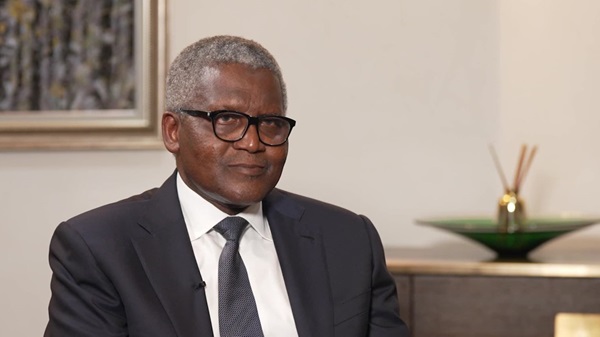
The President and Chief Executive of Dangote Industries Limited, Aliko Dangote, has revealed that Nigerian banks charged his company interest rates of up to 40 per cent when it secured local financing for the construction of its Obajana Cement plant in Kogi State.
Dangote disclosed this on Thursday at the 25th annual conference of Women in Management and Business (WIMBIZ) in Lagos, where he encouraged women entrepreneurs to pursue ambitious business ventures despite financial and infrastructural challenges.
He said the Obajana project, initially estimated to cost $180m, eventually required about $1bn following delays and additional expenditure caused by inadequate infrastructure.
According to him, the company had relied on government assurances that electricity and gas supplies would be available, but subsequently had to invest in additional infrastructure to sustain operations.
Dangote recalled that the company approached the International Finance Corporation (IFC) for additional financing after encountering difficulties. He said local borrowing remained particularly expensive, with interest rates reaching 40 per cent.
He added that he eventually settled the outstanding obligations to the banks six months before the expiration of the 18-month financing arrangement.
The industrialist also recounted the scepticism surrounding the construction of the Dangote Petroleum Refinery, saying several international engineering firms initially doubted the feasibility of the project in Nigeria.
He said the refinery, originally designed for 650,000 barrels per day, had since increased its production capacity to 710,000 barrels per day.
Dangote urged women entrepreneurs to think big, remain confident and refuse to be discouraged by criticism or difficult circumstances.
Earlier, WIMBIZ founding chairperson and trustee, Omobola Johnson, celebrated the organisation’s 25-year journey, attributing its sustainability to inclusion, collaboration, mutual respect and effective succession planning.
She said the organisation had demonstrated that women could work together successfully to build enduring institutions.
