


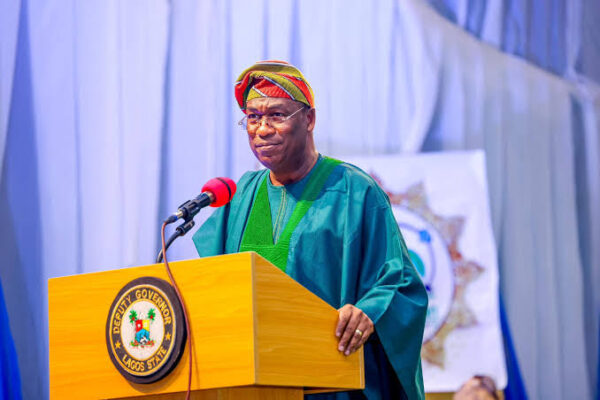
Lagos State Deputy Governor and All Progressives Congress (APC) governorship candidate, Obafemi Hamzat, has criticised his opponents in the 2027 governorship race, claiming they are focused on complaints rather than presenting practical plans for the state.
Hamzat made the remarks on Friday during a governorship debate organised by BusinessDay in partnership with the organised private sector.
The debate featured candidates from several political parties, including Gbadebo Rhodes-Vivour of the African Democratic Congress (ADC), Funso Doherty of the Nigeria Democratic Congress (NDC), Adedeji Doherty of the Peoples Democratic Party (PDP), Oluwapamilerin Odunaike of the Labour Party and Laja Adeoye of the Allied Peoples Movement (APM).
Describing his opponents’ approach as a “manifesto of grievances”, Hamzat said his own campaign was built around a development blueprint.
“My opponents have a manifesto of grievances. I have a blueprint. They say all these years are problems, but I see them as foundations,” he said.
The APC candidate also questioned the political consistency of some contenders, arguing that experience within a political party was important for effective governance.
“In our country, if you cannot manage your political party, you cannot govern a state because you don’t know what it takes to manage a system,” he said.
Hamzat further defended Lagos’ education and healthcare systems against criticism, pointing to Nigerian-trained doctors, nurses, engineers and other professionals working abroad as evidence of the quality of local education.
Zebra News reports that Hamzat also described himself as a product of Lagos’ public education system, saying his personal experience had shaped his confidence in the state’s development.
He emerged as the APC governorship candidate in May after polling 657,917 votes at the party’s primary.
In his acceptance speech, he unveiled a development agenda tagged “My Lagos Dream”, focusing on job creation, infrastructure, education, healthcare and security.
Hamzat said his vision was to sustain Lagos’ position as Africa’s leading commercial hub through strategic investment and people-centred governance.
