


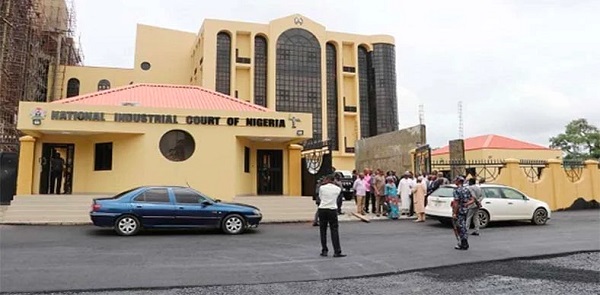
The National Industrial Court of Nigeria (NICN), Abuja, is set to deliver its ruling today (Tuesday) on a suit filed by the Minister of the Federal Capital Territory, Nyesom Wike, alongside the FCT Administration (FCTA), against leaders of the Joint Union Action Committee (JUAC).
Justice E.D. Subilim fixed the date after hearing arguments from both parties in the matter. The suit, marked NICN/ABJ/17/2026, was brought against JUAC Chairman, Rifkatu Iortyer, and Secretary, Abdullahi Umar Saleh. The claimants are seeking an interlocutory injunction to restrain the union and its representatives from continuing the ongoing industrial action, including picketing and any form of work stoppage.
The strike, which began last Monday following the expiration of a seven-day ultimatum, has disrupted operations across key FCTA offices in Abuja. Activities at the FCTA Secretariat have been largely grounded, with security operatives deployed to control access to the premises.
While FCTA management insists that the majority of workers’ demands have been addressed, the union has rejected the claim, maintaining that several critical issues remain unresolved.
At Monday’s hearing, counsel to the union, Maxwell Opara, urged the court to dismiss the application, arguing that granting the injunction would effectively resolve the substantive issues in dispute at an interim stage. He relied on a Supreme Court precedent, warning that compelling workers to resume duties without settling outstanding salary issues could worsen tensions. Opara also called for arbitration and requested that the court consider compelling the FCT minister to participate in mediation.
After listening to submissions, Justice Subilim adjourned the case to January 27 for ruling.
Speaking to journalists after the proceedings, counsel to the FCTA, James Onoja (SAN), argued that JUAC lacked legal standing, describing it as an unregistered and illegal body under both the Companies and Allied Matters Act and the Trade Union Act. According to him, JUAC had no legal authority to declare a strike, rendering the ongoing action unlawful.
Onoja maintained that the government was open to dialogue and that due process was not followed before the strike was called.
In response, Opara countered that the union had written multiple letters—no fewer than 11—to the minister, clearly outlining its grievances and requesting mediation. He accused the FCTA of resorting to court action as a means of intimidating workers instead of engaging constructively.
He also explained that the Nigeria Labour Congress (NLC) and the Trade Union Congress (TUC) were joined in the suit because JUAC operates under their umbrella, and any court order affecting the strike would necessarily involve them as key stakeholders.
Ahead of the court session on Monday, workers from the FCTA and the Federal Capital Development Agency (FCDA), supported by the NLC, staged a protest outside the Industrial Court, demanding the removal of the FCT minister.
The NLC has thrown its full support behind the strike, describing it as a legitimate response to alleged violations of workers’ rights, including wage-related issues, intimidation, and failure to meet statutory obligations.
Protesters displayed placards bearing messages such as “Wike must go,” “Pay promotion arrears,” “Respect civil service rules,” and “Enough is enough,” among others.
Several other unions, including the Nigerian Union of Teachers, the National Association of Nigeria Nurses and Midwives, the National Union of Electricity Employees, and the Nigeria Union of Journalists (FCT chapter), have also joined the industrial action in solidarity.
