


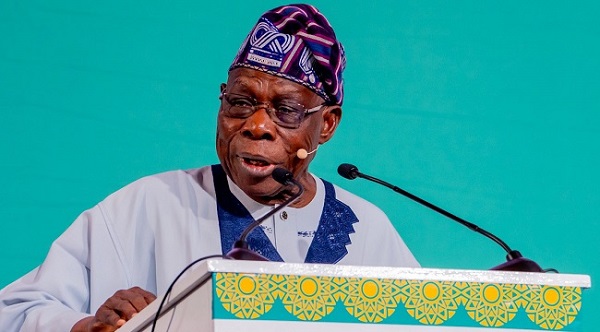
Former Nigerian President Olusegun Obasanjo has firmly denied long-standing allegations that he attempted to extend his presidency beyond the constitutional two terms, describing such claims as unfounded and baseless.
Speaking on Wednesday at the Democracy Dialogue organised by the Goodluck Jonathan Foundation in Accra, Ghana, Obasanjo said no individual, dead or alive, could produce evidence that he ever sought a third term in office.
“I’m not a fool. If I wanted a third term, I know how to go about it. And there is no Nigerian, dead or alive, that would say I called him and told him I wanted a third term,” the former president declared.
Obasanjo, who served as Nigeria’s civilian president from 1999 to 2007, highlighted the complexity of securing international debt relief during his administration, arguing that the achievement was a far greater political challenge than any bid to extend his tenure.
“I keep telling them that, look, if I wanted to get debt relief, which is more difficult than getting a third term, and I got it — if I wanted a third term, I would have got it too,” he added.
The former leader also issued a stern warning to African leaders who attempt to cling to power indefinitely, describing the belief that a country cannot function without a particular leader as both dangerous and blasphemous.
“I believe that is a sin against God,” Obasanjo said. “Because if God takes you away, which He can do anytime, then somebody else will come — and that person may do better or may do worse.”
He further emphasized the importance of leadership renewal, stressing that effective governance often comes from younger, more dynamic individuals.
“I know that the best is done when you are young, ideal, vibrant, and dynamic. When you are ‘kuje kuje’ [a local slang implying old or ineffective], you don’t have the best,” he said.
The comments come amid ongoing debates across Africa about term limits and democratic governance, with several countries facing criticism over constitutional amendments allowing extended presidential tenures.
