


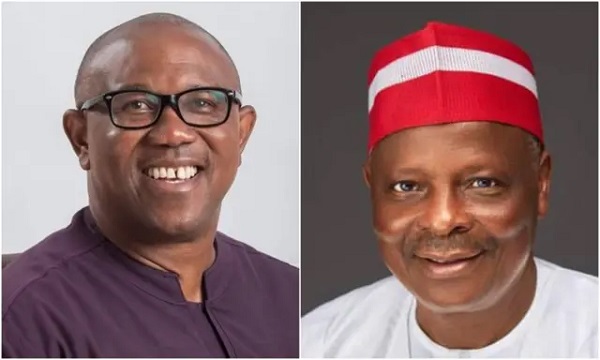
Political camps loyal to Rabiu Kwankwaso and Peter Obi have confirmed ongoing discussions that could lead to a joint presidential ticket ahead of Nigeria’s 2027 general election.
The development comes amid wider political realignments, with Kwankwaso expected to formally join the African Democratic Congress (ADC), where he is set to be received by party leaders including David Mark and Rauf Aregbesola.
Sources indicate that the former Kano governor may be joined in the move by his political allies, including former deputy governor Aminu Gwarzo.
Kwankwaso’s anticipated defection follows a series of high-level political engagements, including a recent meeting with former Vice President Atiku Abubakar in Abuja. He had also hosted Obi during the Sallah period in Kano, alongside Seyi Makinde and Seriake Dickson.
On Sunday, Kwankwaso confirmed his resignation from the New Nigeria People’s Party, describing the move as part of a broader strategy to reposition himself within Nigeria’s evolving political landscape.
“As a committed member of the party, this was not an easy decision,” he said, adding that the current political climate required “strategic realignment”.
Party officials within the NNPP have acknowledged that a potential alliance between Kwankwaso and Obi could trigger significant political shifts. The party’s National Publicity Secretary suggested that any collaboration between the two figures would likely result in a broader movement, possibly involving multiple platforms.
Meanwhile, Obi’s allies have indicated that the idea of a joint ticket is gaining public support. Yunusa Tanko, a key figure within the Obidient Movement, said the proposal appears increasingly popular among voters.
“It seems to be the most acceptable option if tested through public opinion,” he said, adding that both leaders may now be more open to collaboration following the outcome of the 2023 election.
Tanko dismissed speculation about the formation of a new political party, arguing that time constraints make such a move impractical. Instead, he suggested that opposition groups could coalesce under an existing platform ahead of the next election cycle.
The talks have also sparked discussions about a broader opposition alliance, with some stakeholders advocating a unified front to challenge the ruling party in 2027.
However, both the NNPP and Obi’s supporters have rejected claims that recent political gatherings—particularly Obi’s visit to Kano—were staged using paid crowds. Representatives from both camps described the turnout as spontaneous, attributing it to genuine grassroots support.
Observers say the evolving relationship between Kwankwaso and Obi could reshape Nigeria’s political landscape, particularly if it leads to a formal coalition capable of mobilising support across key regions.
