


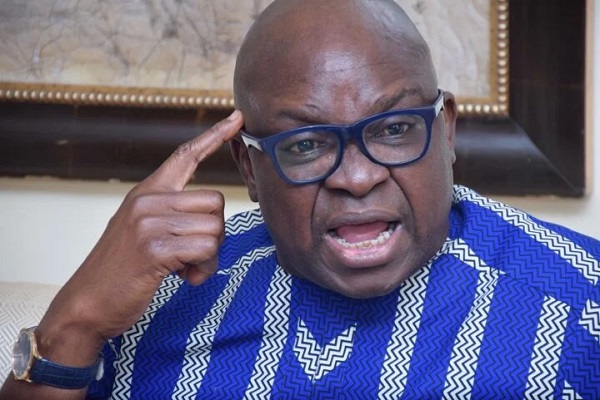
After nearly seven years of legal battles and public scrutiny, former Ekiti State Governor Ayodele Fayose walked out of a Lagos courtroom on Wednesday a free man—cleared of all N6.9 billion fraud charges filed against him by the Economic and Financial Crimes Commission (EFCC).
In an emotionally charged scene outside the Federal High Court in Ikoyi, Fayose broke down in tears. Supporters surrounded him in celebration as he knelt down on the courthouse steps, lifting his hands in thanksgiving. “Winner ooo, winner!” he sang with raw emotion, echoing the relief of a man who had waited years for this moment.
The case, originally filed in October 2018, accused Fayose of money laundering during his tenure as governor between 2014 and 2018. The EFCC alleged he accepted N1.2 billion to fund his 2014 campaign, and received $5 million in cash from then-Minister of State for Defence, Musiliu Obanikoro, bypassing financial institutions in violation of the Money Laundering (Prohibition) Act.
Additional allegations included the laundering of over N1.6 billion through various proxies and companies such as De Privateer Ltd and Still Earth Ltd. But at every stage, Fayose maintained his innocence—and on Wednesday, the court agreed.
Justice Chukwujekwu Aneke upheld a no-case submission filed by Fayose’s legal team, ruling that the EFCC had failed to establish a prima facie case against him or his company, Spotless Investment Limited.
During the final hearing on May 19, 2025, Fayose’s lead counsel, Chief Kanu Agabi (SAN), challenged the prosecution’s logic: “You cannot allege conspiracy without a second party,” he argued, noting that a key figure in the alleged transactions, Abiodun Agbele, was not charged alongside Fayose.
The defence further contended that the EFCC presented no direct evidence linking Fayose to money laundering, relying instead on speculation and assumptions. Counsel for Spotless Investment, Olalekan Ojo (SAN), echoed the same position, joining the no-case submission that ultimately led to acquittal.
The EFCC, however, maintained that the nature of the transactions raised red flags. “If the money was clean, why didn’t he acquire the properties in his own name?” asked Rotimi Jacobs (SAN), counsel for the anti-graft agency, citing testimonies from Obanikoro and EFCC investigators.
But the court remained unconvinced. In a decisive ruling, Justice Aneke said the prosecution’s case lacked sufficient evidence to compel the defendants to open a defence. Both Fayose and Spotless Investment were discharged and acquitted.
As Fayose embraced his legal team outside the court—tears rolling down his face—it was clear this was more than a legal win; it was personal vindication.
“This is not just my victory,” Fayose said quietly to reporters, “this is a victory for truth and for everyone who stood by me.”
Still, the case may not be entirely over.
The EFCC has vowed to appeal the ruling. In a statement issued shortly after the judgment, the commission said it is currently reviewing the verdict and preparing its next steps.
For now, Fayose walks away with his name cleared, but the legal dust hasn’t fully settled. With the EFCC gearing up for an appeal, another chapter could yet unfold.
Still, for the former governor, July 16, 2025, will be remembered as the day he walked out of court not as a defendant, but as a man vindicated—at least for now.
