


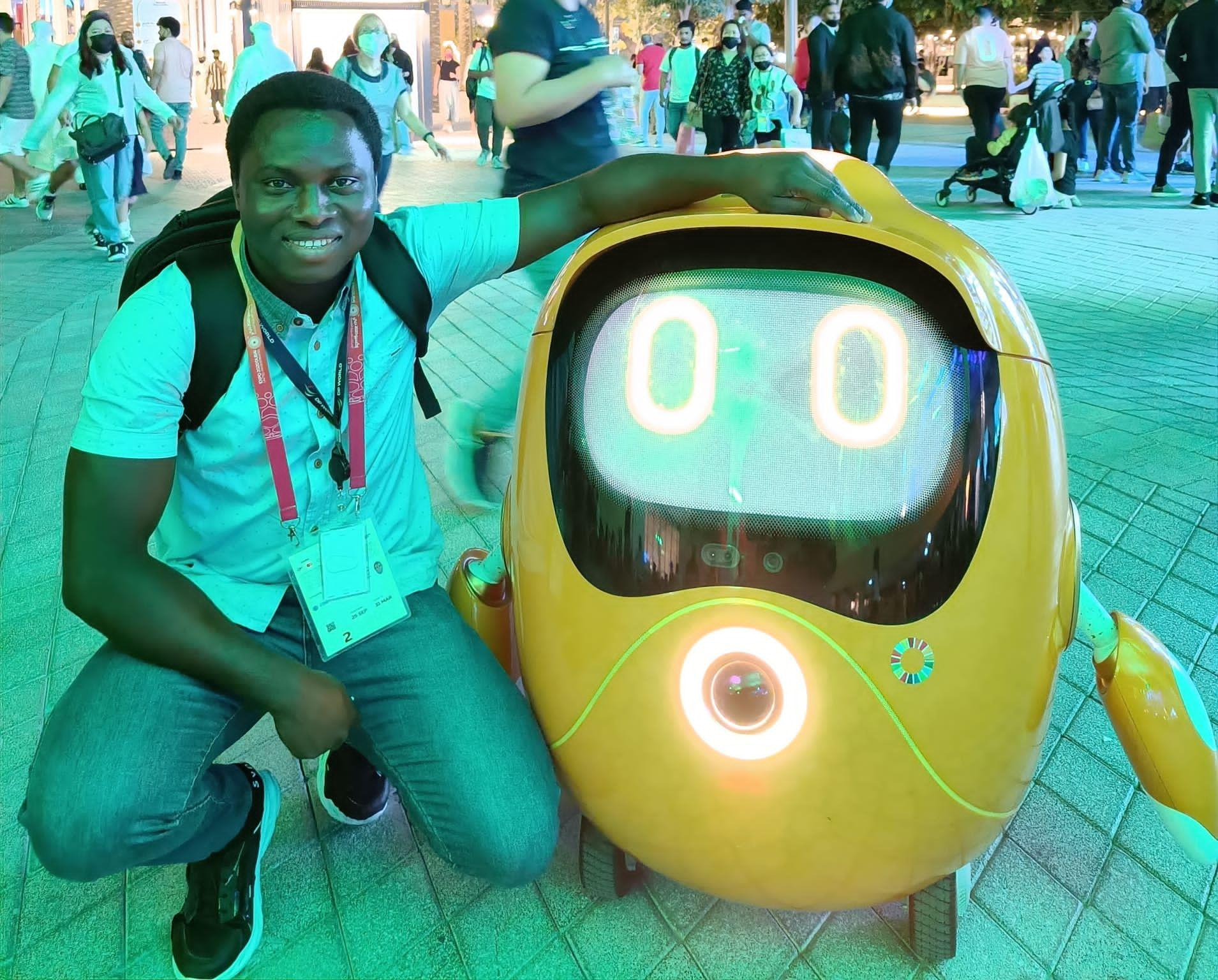
One of the largest gatherings of global innovation ever staged in recent times, Expo 2020 Dubai, held from October 1, 2021 to March 31, 2022, showcased technologies from nearly every country. We spoke with Tomilola Boyinde, a Nigerian creative who worked at the Expo as Media Ambassador for one of the event’s premier partners, DP World, and visited all pavilions across the site to document the technologies and innovations on display. In this interview, he reflects on his role, experiences and why storytelling has become essential to technology communication in the digital economy.
Expo 2020 Dubai was an enormous event. When you arrived, how did you define your role within such a complex innovation environment?
From the beginning, I didn’t see Expo 2020 Dubai as something to simply document. I saw it as a living system of ideas. You had governments, startups, multinational companies, researchers, and creatives all presenting technologies that could shape how people live and work in the future. My role, as I understood it, was to act as a bridge. Many of these technologies are powerful, but they’re also abstract if you don’t work directly in those fields. I focused on interpretation rather than promotion: helping people understand what these innovations actually do, who they’re for, and why they matter.
You were a Media Ambassador for DP World. How did that position shape your exposure to digital technology at the Expo?
DP World Flow Pavilion where I was engaged was a perfect environment for someone interested in applied digital technology. Logistics today is no longer just about moving goods; it’s about data, automation, predictive systems, and digital infrastructure that connects the world. Being part of that space meant engaging daily with ideas around smart ports, AI-powered supply chains, and digitally enabled trade. My work involved supporting media and digital marketing efforts, but also explaining these systems to visitors who might never have thought about how deeply technology underpins global commerce.
That experience reinforced something important for me: some of the most influential technologies are invisible. If people don’t understand them, they underestimate their impact.
Alongside your official role, you initiated World Expo Stories. Why was it important for you to create an independent digital project?
I wanted the freedom to explore the Expo holistically. World Expo Stories wasn’t tied to any single pavilion or organisation. It allowed me to move across the site, ask questions freely, and connect patterns across regions. The Expo had 192 country pavilions, and each one told a different version of the future. By creating an independent project, I could document those visions and place them in conversation with one another. It became less about individual exhibits and more about global trends and how different parts of the world are using technology to solve similar problems in different ways.
You covered more than 192 country pavilions. What stood out to you across that journey?
Two things stood out very strongly. First, innovation is no longer concentrated in a few regions. You see technological solutions emerging from Africa, Southeast Asia, Latin America, often designed specifically for local challenges but with global relevance. Second, many countries were approaching technology from a human-centred perspective. Whether it was climate-tech in Europe, smart mobility in the Americas, or clean-energy solutions in Africa, the focus wasn’t just on capability, but on impact. That made storytelling even more important, because the technology only makes sense when you understand the problem it’s trying to solve.
Your content focused heavily on LinkedIn. Why that platform?
LinkedIn sits at an interesting intersection. It’s professional, but it’s also conversational. I was speaking to people who work in different fields, be it technology, policy, marketing, education, and business, but not all of them are technical specialists. LinkedIn allowed me to publish long-form insights, images, and reflections that could spark discussion. The goal wasn’t to impress people with complexity, but to invite them into the conversation. When you see professionals from different countries engaging with the same post, you realise digital platforms can function as global classrooms.
How did you approach explaining complex digital technologies without oversimplifying them?
That’s always a balance. I tried to start with the “why” before the “how.” Instead of leading with technical specifications, I focused on what problem the technology was addressing. Once people understand the purpose, they’re more willing to engage with the mechanics. I also asked a lot of questions directly to innovators, questions I thought a curious but non-technical reader would ask. That helped keep the explanations grounded.
Beyond content creation, you also led guided tours for high-profile visitors. What did that experience require from you professionally?
Leading guided tours is very different from writing. You’re engaging in real-time dialogue with government officials, founders, executives, and media professionals from al over the world. You need confidence, clarity, and a solid grasp of the technologies being discussed. Those tours required me to contextualise digital systems quickly, sometimes adapting explanations based on the background of the audience. It reinforced the idea that communication itself is a leadership skill, especially in technology-driven environments.
How do you see technology communication fitting into the broader digital technology ecosystem?
Technology communication is no longer optional. As systems become more complex and more embedded in daily life, societies need translators, people who can explain, contextualise, and humanise technology. Without that layer, innovation risks becoming disconnected from the people it’s meant to serve. I see technology communicators as contributors to the ecosystem, not observers. We help shape adoption, trust, and understanding.
Looking back, what do you think was the public impact of your work at the Expo?
For many people, World Expo Stories was their only exposure to Expo 2020 Dubai. They couldn’t attend physically, but they could still engage with the ideas. The comments and messages I received from professionals, students, and creatives across different countries made it clear that people were learning, reflecting, and sometimes rethinking their own work because of what they read. That, to me, is impact. Not virality for its own sake, but meaningful engagement with ideas.
Finally, what does Expo 2020 Dubai represent to you now that it has ended?
It represents a moment when the world paused to imagine the future together. But more importantly, it showed that innovation doesn’t end when the event closes. Ideas live on through conversation, documentation, and shared understanding. If my work helped even a small part of that future feel more accessible, then it did what it was meant to do.
