


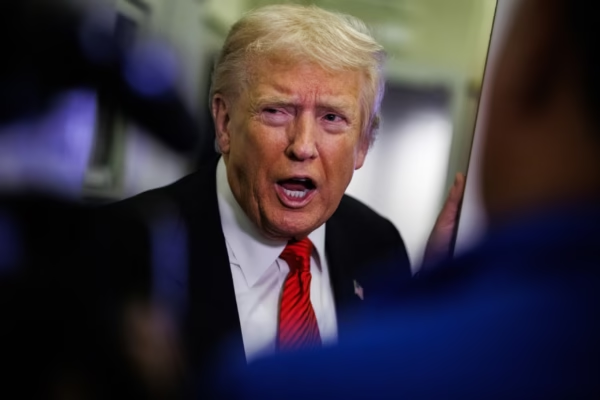
The President of the United States, Donald Trump, has dismissed concerns over rising global oil prices, warning that Washington could target Iran’s key energy infrastructure if Tehran fails to agree swiftly to a peace settlement.
In remarks made on Monday, Mr Trump suggested the United States could strike major Iranian assets, including oil wells, power stations and the country’s principal export hub at Kharg Island. The warning followed earlier comments in which he raised the prospect of deploying ground troops to seize the strategic facility—remarks that had already unsettled global markets.
In a strongly worded social media statement, Mr Trump said he remained optimistic about reaching a negotiated agreement. However, he cautioned that failure to do so—or any continued disruption by Iran to shipping through the Strait of Hormuz—could trigger decisive military action.
Iran has previously warned that further attacks on its economic infrastructure by the United States or Israel would prompt retaliation against energy facilities in neighbouring Gulf states. The conflict, now entering its second month, has already disrupted global markets and intensified economic uncertainty.
Analysts say the situation risks driving oil prices to historic highs. During the 2008 oil price spike, Brent crude approached 150 dollars per barrel. Experts warn that current tensions could push prices significantly beyond that level.
Crude benchmarks have already risen sharply in recent weeks, with Brent climbing by nearly 60 per cent this month and US benchmark West Texas Intermediate also posting substantial gains. Market observers caution that any escalation—such as a US ground offensive or broader Iranian retaliation—could send prices towards 200 dollars per barrel.
Meanwhile, hostilities continue to intensify across the region. Israel has expanded its military operations against Hezbollah in southern Lebanon, with reports of casualties on multiple sides. The Israel Defense Forces said it had responded to missile launches originating from Iran, while also carrying out strikes on military targets in Tehran.
Among the sites reportedly hit in recent days is Imam Hossein University, which Israel claims is used by the Islamic Revolutionary Guard Corps for advanced weapons research. Tehran has issued warnings that it could respond by targeting US-linked facilities across the region.
Diplomatic efforts are continuing in parallel. Pakistan has positioned itself as a mediator, hosting talks in Islamabad involving senior officials from Saudi Arabia, Turkey and Egypt. Pakistan’s foreign minister, Ishaq Dar, said discussions had focused on securing a swift and lasting end to the conflict.
He added that both Iran and the United States had expressed confidence in Pakistan’s role as a facilitator, noting consultations with Wang Yi and Antonio Guterres, among others, who support renewed diplomatic engagement.
However, scepticism remains in Tehran, where parliamentary leaders have accused Washington of using diplomacy as a cover while expanding its military presence in the region. Recent US deployments reportedly include an amphibious assault ship carrying thousands of Marines.
For civilians in Iran, the impact has been severe. Residents in Tehran describe sustained overnight bombardments, with one local reporting that the intensity of strikes has made normal life increasingly difficult.
The conflict has also disrupted vital global energy routes. Iran says it has restricted access through the Strait of Hormuz—a critical corridor that previously handled a significant share of the world’s oil and liquefied natural gas shipments—further heightening concerns over supply and economic stability.
