


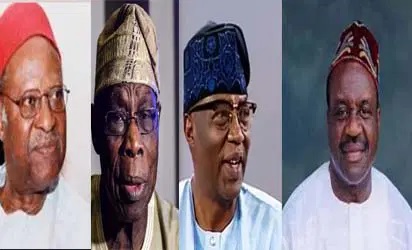
The debate over the legitimacy of Nigeria’s 1999 Constitution reached a boiling point this week as prominent statesmen and legal minds gathered at the National Summit on the Future of Nigeria’s Constitutional Democracy, held in Abuja.
The three-day summit—convened by The Patriots in collaboration with the Nigeria Political Summit Group—brought together political heavyweights, legal experts, civil society leaders, and former government officials to dissect the legal foundation of Nigeria’s democratic structure. But unity was elusive as former President Olusegun Obasanjo, human rights lawyer Femi Falana (SAN), ex-Commonwealth Secretary-General Chief Emeka Anyaoku, and former Akwa Ibom State Governor Victor Attah offered sharply contrasting views.
Obasanjo: It’s Not the Constitution, It’s the Leadership
Speaking through Olawale Okunniyi, Secretary-General of Eminent Patriots, Obasanjo argued that Nigeria’s democratic failures stem not from the constitution itself, but from the people entrusted to implement it.
“Our constitution needs amendment, yes, but the core problem is the operators. The best constitution can be perverted by bad actors,” he said.
“In the last 15 years, we’ve seen the constitution sacrificed on the altar of selfishness, corruption, and impunity.”
Obasanjo warned that no amendment could fix Nigeria unless its political leaders embraced integrity and accountability.
Falana: Revolution Needed to Discard 1999 Constitution
Femi Falana, however, dismissed the constitution altogether as a relic of military authoritarianism that must be rejected through collective civic action.
“The only way to discard the 1999 Constitution is through a revolution,” he declared.
“The political elite resist meaningful reform. The courts have rendered technologies like BVAS and card readers almost useless, while the National Assembly’s constitutional review is merely performative.”
Falana criticized a system that shields the powerful and stifles electoral innovation, urging citizens to increase pressure for radical reform.
Attah: The 1999 Constitution Is a Fraud
Former Akwa Ibom Governor Victor Attah pulled no punches in his assessment, describing the constitution as a “fraudulent decree” that lacks public legitimacy.
“It robbed Nigerians of their sovereignty and replaced democracy with elite authoritarianism,” Attah said.
“We need a return to true federalism, with state autonomy, a unicameral legislature, and elected ministers who can be recalled by the people.”
He blamed the current structure for eroding public trust and diminishing voter participation.
Anyaoku: A New, Inclusive Constitution Is the Only Way Forward
Chief Emeka Anyaoku, a veteran diplomat and statesman, called for a people-led constitutional process.
“The 1999 Constitution was imposed by military decree. It promotes excessive bureaucracy and hinders national cohesion,” he said.
“Nigeria must adopt a truly federal constitution—one crafted by elected representatives—to ensure equitable development and democratic legitimacy.”
Voices from the Regions: PANDEF and Afenifere Weigh In
The Pan Niger Delta Forum (PANDEF), represented by Ambassador Godknows Igali, called for a return to the principles of the 1963 Constitution. Their proposals include:
- State policing
- Resource control
- A rotational presidency
- Increased derivation for oil-producing states
- A single legislative chamber
Afenifere, the Yoruba socio-political group, also pushed for restructuring, urging the government to adopt the 2014 National Conference Report as a starting point for national reforms.
Next Steps: Toward a Communique for Action
Senator Gbenga Daniel, Co-Chair of the Summit Organising Committee, said the summit’s conclusions will be documented and forwarded to both the Presidency and the National Assembly.
“We are addressing the core questions—federalism, electoral reform, judiciary independence, and local governance,” he noted.
“The time has come to reshape Nigeria’s democratic future.”
Conclusion: A Nation at a Crossroads
The summit highlighted a growing national consensus: Nigeria’s current constitutional structure no longer serves the needs of its diverse population. While opinions diverged on how to move forward—through reform, replacement, or revolution—the call for fundamental change is now louder than ever.
