


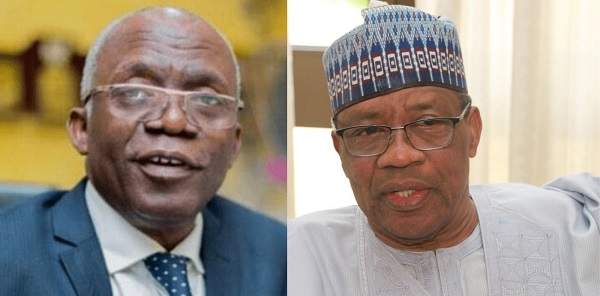
Renowned human rights lawyer, Femi Falana, SAN, has vowed to take legal action against what he describes as his “malicious” detention during the military regime of General Ibrahim Babangida (retd.), alongside the late Chief Gani Fawehinmi (SAN) and three others.
In an interview on Channels TV on Tuesday, Falana revealed that he and his colleagues were persecuted for their opposition to the annulment of the June 12, 1993, presidential election, which was won by Chief Moshood Kashimawo Olawale (MKO) Abiola.
Describing their detention, prosecution, and trial as a deliberate act, Falana confirmed that he has now assembled a legal team to seek redress.
Reflecting on the events, Falana lamented that 32 years later, Babangida had admitted to regretting the annulment of the election. He accused the former military leader of intentionally nullifying the election results and arresting, detaining, and parading them as criminals.
Falana recounted how he and his colleagues were charged with treasonable felony at the Gwagwalada Chief Magistrate Court in 1993. Without access to legal representation, Falana and the late Gani Fawehinmi defended themselves and their colleagues in court.
The human rights lawyer stressed that Babangida’s actions had lasting consequences on Nigeria’s democracy and reiterated that he is now seeking justice for the wrongful prosecution.
“Even though we were asking for bail, we turned our arraignment to the trial of junta. And I recalled on that occasion, Chief Fawehinmi told the judge, Chief Magistrate Mallam Bulama that those who should be standing trial for treason, should be in the dock were in the Villa, led by General Babangida.
“Because they had sacked, they had overthrown a democratically elected government on December 31, 1983. So, those are the people that should be standing trial. And of course, when it came to my turn, I made it clear to the judge, this section of the law, Section 41 of the Criminal Code Act, which provides anybody who forms an intention to remove the president of his country, during his term of office, otherwise than by constitutional means.
“I said, my lord? The man calling himself my president has no fixed term of office. So, I couldn’t have been brought here. Of course, the judge adjourned. Two weeks later, he granted us bail very liberally, N20,000 and one surety in like sum.”
The human rights lawyer noted that Babangida’s regime could not stand another proceeding.
“They couldn’t go back to court, so that we don’t turn the thing into a full trial of General Babangida and others. So, it simply ran away,” he said.
Falana added that the case was struck out.
“So, I am going to challenge the malicious prosecution. My malicious prosecution and that of my colleagues.
“I have assembled a team of lawyers. They are looking into it. Because he has now brought it to life by now admitting that there was no basis for my prosecution. Because he now says Abiola won the election, which was the basis of our protests.
“He is also saying, you know, it shouldn’t have postponed the terminal date of his transition programme,” he said.
“Which, again, we are fighting. So, which means there was no basis for our prosecution. It is malicious,” Falana said.
“Again, massive infringements of our rights, human rights. Because when you keep me in Kuje prison, you deny me my right to liberty, my freedom of movement. You also violate my right to choose the government of my country.
“Point to Article 13 of the African Charter on Human Rights. Because the man who did it has just come out to say, I did it wrongly,” he said.
Falana further explained that, echoing the ruling of the court in Abuja in the case of Femi Falana vs. Republic of Benin and others, the court stated that any violation occurring after three years cannot be pursued in the jurisdiction.
“But later, you know, the improvement of the jurisprudence of the court has now come to the conclusion. I think that was in the case of the Federation of Journalists, you know, Gambia and the government of that country that once you are talking of serious abuse of human rights, statute of limitation does not apply,” Falana added.
