


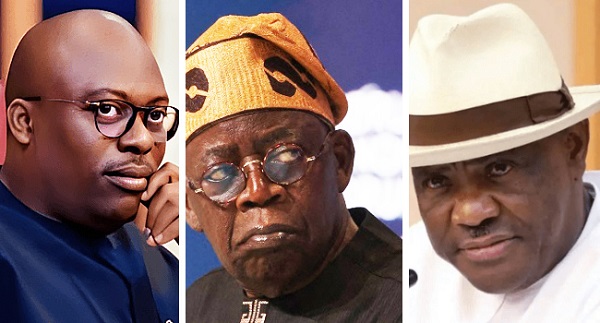
…Seeks Port Reforms to Revive Economy
Governor Siminalayi Fubara of Rivers State has declared that peace has returned between him and his political benefactor, Nyesom Wike, following a prolonged feud that plunged the oil-rich state into a governance crisis earlier this year.
Speaking to journalists at the Presidential Villa, Abuja, on Monday, after a closed-door meeting with President Bola Tinubu, Fubara said the rift between him and Wike—former Rivers governor and current Minister of the Federal Capital Territory—had been resolved.
“As far as I’m concerned, we have made peace. Fubara and his principal are working together,” he said. “It was a father-son discussion, telling Mr. President thank you and seeking guidance to avoid future crises.”
The visit came days after President Tinubu formally lifted the emergency rule imposed on Rivers State in March, which suspended key institutions, including the governor, deputy governor, and House of Assembly, following months of political infighting between factions loyal to Fubara and Wike.
The Supreme Court had previously warned that governance in Rivers had “collapsed,” while attacks on vital oil infrastructure heightened fears of instability.
Later on Monday, Fubara shifted focus to economic development, calling for urgent action to revive operations at the Port Harcourt and Onne seaports, describing them as critical but underutilised national assets.
Speaking during a courtesy visit by the Board and Management of the Nigerian Ports Authority (NPA) at the Government House, Port Harcourt, the governor lamented the economic losses suffered by the state and the nation due to the ports’ underperformance.
“We are blessed with the Port Harcourt and Onne seaports, but the truth is they are underutilised,” Fubara said. “Imagine Onne Port operating at full capacity—the impact on the economies of Eleme, Tai, and surrounding LGAs would be transformational.”
According to Fubara, an optimised port system would:
- Attract export-driven industries,
- Create jobs,
- Lower logistics costs,
- Stimulate investor confidence, and
- Generate higher tax revenues.
He blamed poor access roads, insecurity, and lack of synergy between stakeholders for stalling growth, but assured the NPA of his administration’s support in addressing these challenges.
“Even though federal roads fall outside our jurisdiction, we will support you through improved traffic management, enforcement, and collaborative infrastructure efforts,” he stated.
Fubara also promised to:
- Establish a new police station within the port corridor to boost security,
- Crack down on land encroachment, and
- Partner with the NPA to address flooding through joint drainage and road interventions.
He attributed high insecurity to youth unemployment, saying: “If activities pick up at the ports, nobody will want to be a criminal when there are genuine opportunities to make a living.”
The governor commended the NPA for engaging with the state before initiating intervention projects, stressing that government collaboration ensures community buy-in and sustainability. “When government is part of your programmes, it means you have already succeeded,” he added.
In his remarks, NPA Board Chairman, Senator Adeyeye Adedayo Clement, acknowledged the vast economic potential of Nigeria’s coastal states and affirmed the Board’s commitment to reviving the Port Harcourt and Onne ports.
He requested the state government’s support in rehabilitating road networks, managing environmental cleanliness, curbing illegal truck parking, and enhancing port security through a new police post.
“Nigeria’s littoral states are endowed with marine assets that, if harnessed, can catalyse rapid economic growth,” he said.
