


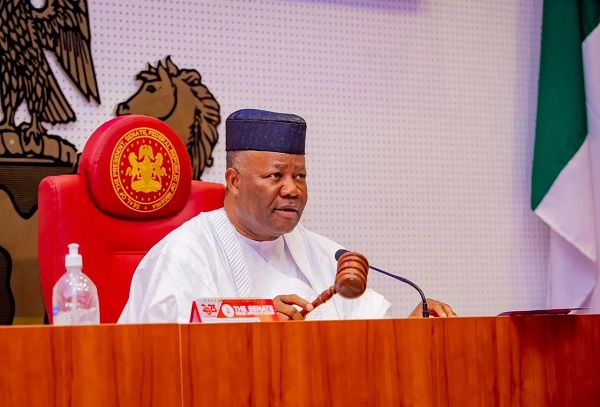
Senate President Godswill Akpabio has declared that the National Assembly, particularly the 10th Senate, will not be held hostage by what he described as the “disruptive instincts” of any lawmaker. He insisted that parliamentary discipline is crucial to safeguarding Nigeria’s democracy.
In a statement issued on Saturday by his media aide, Eseme Eyiboh, titled “The Trials and Triumphs of a Resilient Nigeria’s 10th Senate,” Akpabio emphasized that the enforcement of legislative rules is not an attempt to silence dissent, but to uphold order, institutional integrity, and democratic values.
“The Senate cannot and will not be held hostage by the disruptive instincts of any of its members,” Akpabio stated.
“Democracy thrives only when its institutions are respected and its rules upheld.”
Although Akpabio did not mention any lawmaker by name, his remarks come amid the controversy surrounding Senator Natasha Akpoti-Uduaghan (Kogi Central), who recently returned to the chamber after a six-month suspension that she is still contesting.
Drawing comparisons with parliaments in established democracies such as the United Kingdom, Canada, and Australia, Akpabio said discipline within legislative chambers is the hallmark of political civilization.
“In the United Kingdom’s House of Commons, the authority of the Speaker is absolute and unchallenged. No member, regardless of party or popularity, may openly defy the Speaker’s ruling without consequences,” he said.
Akpabio rejected claims that Nigeria’s Senate Standing Orders were outdated or symbolic, stressing that they are “living instruments” essential for fairness and legislative order.
“They are not ceremonial relics from the past. They are the living constitution of the institution, carefully designed to preserve fairness, consistency, and the sanctity of the legislative process.”
He defended the Senate’s constitutional right to discipline its members when necessary, adding that in many advanced democracies, lawmakers face suspension or even expulsion for behavior that undermines parliamentary dignity.
“In the world’s most respected parliaments, members who flout rules face swift consequences. Nigeria’s Senate has every right to apply similar standards.”
Describing the 10th Senate as “a chamber of resilience and balance,” Akpabio said his leadership is rooted in firmness, inclusion, and stability, especially in an era of growing populism and public cynicism.
“When the chamber asserts that it will not be held hostage by the disruptive instincts of any single member, it is affirming the primacy of collective responsibility over individual grandstanding,” he said.
“Leadership of this sort does not seek applause; it seeks stability. By upholding its Standing Orders, the Senate has reclaimed its moral authority and demonstrated that rules, properly enforced, are not instruments of oppression but shields against institutional decay.”
Akpabio’s remarks contribute to ongoing debates about the limits of free expression, the role of dissent, and the enforcement of disciplinary procedures within Nigeria’s legislature.
