


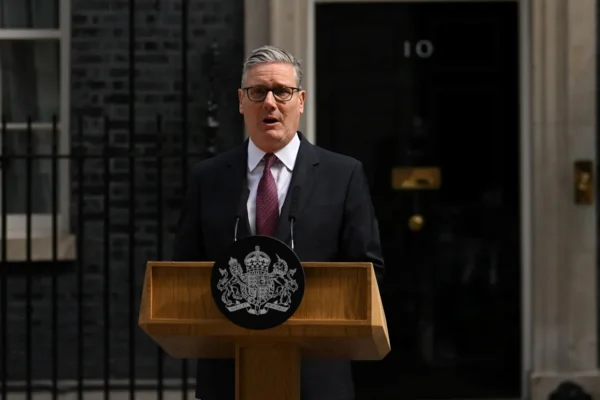
UK Prime Minister Sir Keir Starmer has announced that he will resign as both prime minister and leader of the Labour Party after losing the confidence of members of his parliamentary party.
In an emotional address outside 10 Downing Street on Monday, Starmer described becoming prime minister as the “proudest moment” of his life, highlighting achievements during his time in office, including restoring Britain’s international reputation, securing investment and strengthening workers’ rights.
However, he acknowledged that many Labour MPs no longer believed he was the right person to lead the party into the next general election.
“I have heard the answer from my parliamentary party. I accept that answer with good grace. I will resign as leader of the Labour Party,” Starmer said.
Zebra News understands that Starmer will remain in office until the Labour Party elects a new leader, with the leadership contest expected to conclude before Parliament returns from its summer recess.
The resignation follows growing unrest within the governing party, intensified by former Greater Manchester Mayor Andy Burnham’s decisive by-election victory on 18 June, which positioned him as the frontrunner to succeed Starmer. The prime minister had also faced mounting criticism over his government’s fiscal policies, proposed welfare reforms and the appointment of Peter Mandelson as the UK’s ambassador to the United States.
Recent polling reflected the pressure on Starmer’s leadership. An Ipsos survey published last week found that 52% of Britons believed he should step down as prime minister, while only 35% wanted him to remain in office.
Financial markets reacted cautiously to the political developments. Sterling slipped 0.19% against the US dollar to $1.3207, while yields on 10-year UK government bonds remained broadly unchanged at 4.8452%. Investors are closely watching the leadership transition and the potential economic direction of a government led by Burnham.
Zebra News reports that economists have warned the UK’s next leader will inherit significant economic challenges, including high public debt, elevated borrowing costs and persistent inflation. Despite those concerns, analysts note that Britain is not alone among G7 nations in facing fiscal pressures and that markets will be looking for policy continuity during the transition.
