


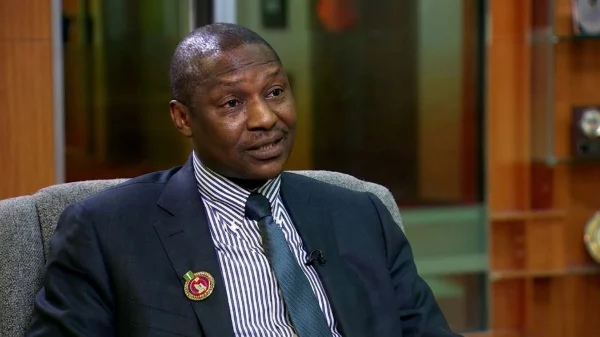
Former Attorney-General of the Federation (AGF), Abubakar Malami, has rejected suggestions that his actions during the dispute between Sunrise Power and the Federal Government over the Mambilla Hydropower Project were motivated by personal financial gain.
Malami was reacting to findings by an International Chamber of Commerce (ICC) tribunal, which ruled that a $200 million settlement reached between Sunrise Power and the Federal Government in 2020 was tainted by corruption and found that Malami stood to benefit from the arrangement.
In a statement issued on Tuesday by his Special Assistant on Media, Mohammed Bello Doka, the former AGF said he acted in Nigeria’s interest and denied entering into any corrupt agreement.
“Malami rejects any suggestion that his official actions were undertaken pursuant to a corrupt agreement or in exchange for personal financial benefit,” the statement said.
“The allegation must ultimately be tested against the complete evidentiary record.”
Background To The Dispute
In January 2020, Malami and then Minister of Power, Saleh Mamman, signed a settlement agreement under which Nigeria was to pay Sunrise Power $200 million over its claims relating to the Mambilla project.
An addendum signed in March divided the settlement into two instalments of $100 million each and exposed Nigeria to an additional $200 million default payment, apart from interest.
Leno Adesanya, the promoter of Sunrise Power, told the tribunal that Malami and Mamman demanded that 50 per cent of the settlement be paid as a bribe.
According to Adesanya, the officials allegedly told him that Nigeria would pay the first $100 million and release the remaining $100 million after he had done “what is needed”.
Adesanya said he rejected the alleged demand and claimed to possess audio and video recordings of the conversations.
However, despite an order from the tribunal, he did not produce the recordings, citing concerns for his safety and that of his family.
The tribunal said it found it implausible that Adesanya would withhold recordings that could have cleared him of wrongdoing. It also noted that the payment structure subsequently included in the settlement addendum resembled Adesanya’s account of the alleged bribe arrangement.
The tribunal concluded that a corrupt agreement had been reached between Adesanya and Malami and identified the promised benefit as a share of the settlement payable to Sunrise.
Although the precise amount allegedly agreed could not be established, the tribunal said Adesanya’s evidence suggested a possible demand of up to $100 million, representing half of the original settlement.
It further found that Malami cooperated in committing Nigeria to the addendum, which could have exposed the country to a $400 million liability, and that he coordinated procedural steps with Adesanya.
The tribunal therefore held that the settlement agreement and its addendum were products of corruption and were unenforceable.
It did not make a corresponding finding against Mamman, stating that the withheld recordings were the only potential direct evidence of his involvement.
No settlement payment was ultimately made because former President Muhammadu Buhari did not approve the arrangement. However, the tribunal said the failure to make the payment did not remove what it considered the corrupt character of the agreement.
Malami Questions Evidence Of Financial Benefit
Responding to the findings, Malami said there was no evidence before the tribunal linking him to any financial benefit arising from the dispute.
“One obvious factual question is whether any money or other financial benefit from Sunrise, Adesanya or any connected entity was ever received by Malami pursuant to the alleged arrangement,” he said.
“The settlement money itself was never paid by the federal government to Sunrise.”
The former AGF also highlighted the recordings referred to by Adesanya, saying their “existence, non-production, authenticity and contents” were matters of “obvious evidentiary importance”.
Malami said the tribunal’s findings should be assessed against the complete evidentiary record.
Malami: Dispute Predated My Tenure
The former AGF also rejected suggestions that he originated the dispute or independently introduced the settlement with Sunrise.
According to his statement, the controversy dated back to 2003, several years before he became attorney-general, and had passed through successive administrations, attorneys-general and government ministries.
Malami said the Federal Government had faced claims running into billions of dollars from Sunrise, while the unresolved dispute had become an obstacle to financing discussions surrounding the Mambilla project.
“The governmental calculation was whether an asserted multibillion-dollar exposure, continuing litigation, financing difficulties and delays to the Mambilla project could be brought to an end through a substantially smaller negotiated settlement,” he said.
“Whether every term ultimately negotiated advanced that objective is a separate question and must be examined on its own evidence.”
Zebra News reports that Malami also acknowledged that Buhari refused to approve payment under the settlement.
The statement said Malami subsequently instructed counsel representing the Federal Government “to resist Sunrise’s attempt to have the settlement terms adopted or enforced against Nigeria and to preserve the Federal Government’s legal position”.
Malami said he would issue a comprehensive response to the tribunal’s individual findings after reviewing the complete award and the underlying records.
