


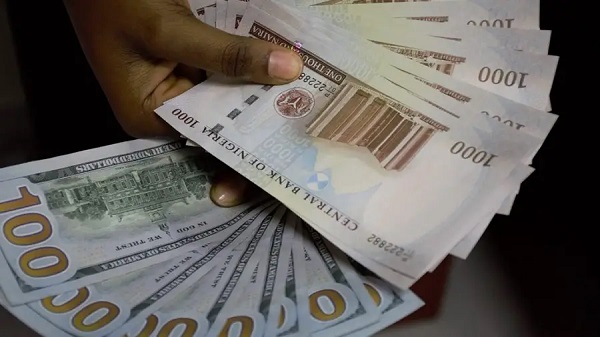
The naira has climbed to one of its strongest levels in nearly two years, buoyed by improved liquidity in the official foreign exchange market. But analysts caution that the rally may come with risks, especially if foreign investors decide to lock in profits later in the year.
In its latest macroeconomic update, Lagos-based investment firm CardinalStone reported that the naira has appreciated by 6.9 percent so far this year in the official market, trading at N1,347.78 to the dollar as of Monday. The firm described the gain as a reflection of healthier FX supply conditions.
Despite the improvement, a price gap remains between the official window and the parallel market.
The parallel market initially traded at a premium of about 5.7 percent over the official rate. However, that spread has since narrowed to roughly 3.2 percent, following renewed foreign exchange interventions by the Central Bank of Nigeria (CBN).
According to CardinalStone, the shrinking gap suggests liquidity in the official market is now stronger than in the parallel segment, a reversal of past trends.
As part of efforts to stabilize the retail end of the market, the CBN recently allowed licensed Bureau de Change (BDC) operators to access foreign exchange through authorized dealers at prevailing rates.
Under the arrangement, each BDC can purchase up to $150,000 weekly, subject to strict Know-Your-Customer (KYC) requirements. Operators are required to offload unused balances within 24 hours to discourage hoarding, while cash transactions are limited to 25 percent of total FX trades.
CardinalStone estimates that with 82 licensed BDCs, supply to that segment could reach about $50 million monthly, significantly lower than the over $1 billion monthly allocation seen before the COVID-19 pandemic. Analysts say this difference reflects structural improvements in the FX market, with more corporate demand now flowing through official channels rather than speculative routes.
While the stronger naira has boosted confidence, analysts warn that continued appreciation may prompt foreign portfolio investors (FPIs) to rebalance their holdings.
Nigeria’s high-yield environment continues to attract investors pursuing carry trade opportunities, borrowing in low-interest environments to invest in higher-yielding markets. CardinalStone estimates outstanding foreign portfolio investments at between $12 billion and $14 billion.
If a significant portion of 2025 inflows entered at around N1,500 to the dollar, a strengthening of the naira to between N1,200 and N1,250 could translate into currency gains of over 22 percent. Such returns, analysts say, may tempt some investors to exit, particularly as political uncertainties build ahead of general elections.
Attention is now turning to the upcoming Monetary Policy Committee meeting of the CBN, where policymakers face mixed economic signals.
Inflation is easing, and short-term interest rates have drifted down to around 22 percent, roughly 500 basis points below the Monetary Policy Rate of 27 percent. However, the CBN has signaled caution over excess liquidity, which it views as a potential threat to recent macroeconomic stability.
So far this year, the apex bank has mopped up N10.9 trillion through Open Market Operations (OMO) and maintained an attractive Standing Deposit Facility (SDF) rate to encourage banks to park funds rather than fuel inflation.
Election-related spending, expected to intensify in the second half of the year, also remains a concern. Analysts note that of the projected N44.2 trillion liquidity expected in 2026, more than 75 percent could enter the system in the first half of the year.
CardinalStone assigns a 60 percent probability that the CBN will hold rates steady while adjusting its policy corridor to keep OMO instruments attractive to both banks and foreign investors. A smaller 40 percent chance exists for a modest rate cut of 50 to 100 basis points.
Despite the naira’s recent surge, forward-market pricing suggests traders expect some weakening later in the year. Six-month non-deliverable forward contracts indicate a rate around N1,449.96 to the dollar in early second half trading.
CardinalStone’s base-case forecast places the naira between N1,350 and N1,450 per dollar in 2026.
For now, however, the currency’s rebound marks a notable turnaround, one that underscores both improved liquidity and the delicate balancing act facing monetary authorities.
