


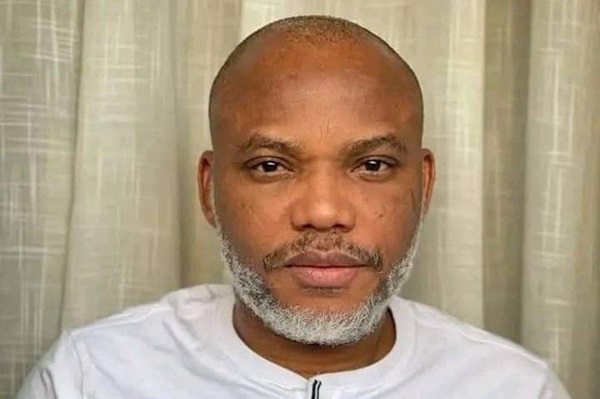
Detained leader of the Indigenous People of Biafra (IPOB), Nnamdi Kanu, on Wednesday told the Federal High Court in Abuja that he has no case to answer in the terrorism and treasonable felony charges brought against him by the Federal Government.
This comes after the prosecution closed its case, having presented five witnesses in support of the allegations. The government’s final witness, referred to only as PW-5 for security reasons and identified by the initials “EEE”, testified behind a protective screen.
Upon completing his cross-examination by Kanu’s legal counsel, Dr. Onyechi Ikpeazu, SAN, the Federal Government’s lead counsel, Chief Adegboyega Awomolo, SAN, announced the closure of the prosecution’s case.
“From the avalanche of evidence tendered through the five witnesses, the government has effectively established the charge against the defendant. I will, therefore, close the case of the prosecution,” Awomolo stated.
In a swift response, Chief Kanu Agabi, SAN, head of the IPOB leader’s legal team, declared their intent to file a no-case submission—a legal strategy which argues that the prosecution has failed to present sufficient evidence to justify continuing the trial.
If the court upholds the no-case submission, the charges would be dismissed, and Kanu discharged.
Justice James Omotosho granted both parties 14 days to submit their written arguments and two days to reply on points of law. The case was adjourned to July 18 for the adoption of the no-case submission.
FG Links Kanu to Violence During EndSARS
Earlier in the proceedings, the final prosecution witness, a Department of State Services (DSS) operative, alleged that Kanu’s broadcasts incited violence during the 2020 EndSARS protests. According to the DSS officer, Kanu’s rhetoric was linked to the deaths of 186 police officers and the destruction of 164 police stations.
The witness admitted under cross-examination that he had never met Kanu and knew him only through media reports. He stated that his assignment was to monitor the fallout of the protests and compile damage assessments based on alleged incitement from Kanu’s radio broadcasts.
The court admitted into evidence several documents, including damage assessment reports, death certificates of police officers, and a certificate of compliance. Kanu’s legal team challenged the admissibility of these documents and promised to address their objections in the final written address.
A Trial Long in the Making
Kanu was first arrested in October 2015 after returning from the United Kingdom and was granted bail on health grounds in April 2017. However, he fled Nigeria following a military raid on his residence in Abia State in September 2017.
He was re-arrested in Kenya in June 2021 and was extraordinarily renditioned to Nigeria, sparking national and international controversy. Since then, he has been in the custody of the DSS.
In April 2022, the Federal High Court struck out 8 of the original 15 charges against him for lacking merit. Later, the Court of Appeal ordered his release and dismissed all charges, but that ruling was suspended after the Federal Government appealed to the Supreme Court.
On December 15, 2023, the Supreme Court overturned the appellate court’s decision, allowing the FG to proceed with the remaining seven-count charge.
As the high-profile case nears a critical juncture, all eyes are now on the July 18 hearing, where the court will decide whether Nnamdi Kanu must face trial or walk free.
