


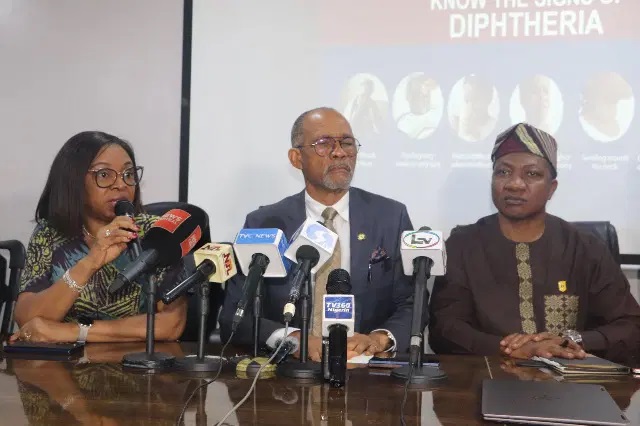
The Lagos State Commissioner for Health, Prof. Akin Abayomi, has reassured residents that there is currently no outbreak of diphtheria in the state.
Abayomi, however, said the state had intensified disease surveillance and response measures as a precaution against possible community transmission.
Speaking at a media briefing on Lagos’ preparedness, the commissioner disclosed that 53 suspected cases of diphtheria had been recorded in the state in 2026, but only six were laboratory-confirmed and subsequently treated.
He explained that increased vigilance was necessary because of the high volume of interstate travel between Lagos and northern states currently experiencing active diphtheria outbreaks, including Kano, Katsina, Kaduna, Benue and Zamfara.
“We are appealing to all Lagosians to remain calm. There is no current outbreak of diphtheria in Lagos. We are simply taking precautionary measures,” Abayomi said.
He added that the state government was deliberately taking preventive steps and strengthening its response systems because of the spread of the disease in other parts of the country.
Abayomi warned that diphtheria is a serious bacterial infection that can block the airway or release toxins capable of damaging the heart.
According to him, the disease can make it difficult for patients to breathe or swallow, while its toxins can enter the bloodstream and affect the heart, potentially leading to heart failure.
The commissioner advised residents experiencing symptoms such as severe sore throat, fever, swollen neck glands or difficulty breathing to seek medical attention immediately, particularly if they had recently travelled to areas affected by the outbreak.
“If you have any of these symptoms, present yourself quickly to one of our primary healthcare centres or your doctor so that we can make the diagnosis, carry out the necessary diagnostic workup and start treatment as quickly as possible,” he said.
Abayomi stressed that early diagnosis significantly improves the effectiveness of diphtheria treatment.
On vaccination, the commissioner revealed that only 64 per cent of children in Lagos currently have full vaccination coverage.
He urged parents and guardians to ensure their children complete the three-dose pentavalent vaccine schedule, administered at six, 10 and 14 weeks.
“If you have received three doses, then you have significant protection. If you have received two, one or none, then you are vulnerable,” Abayomi warned.
Lagos State has also designated four specialised health facilities to manage suspected diphtheria cases and related complications.
The facilities are the Infectious Disease Hospital (IDH), Yaba; Massey Street Children’s Hospital, Lagos Island; Lagos University Teaching Hospital (LUTH), Idi-Araba; and Lagos State University Teaching Hospital (LASUTH), Ikeja.
Abayomi said suspected cases would be referred to the designated centres, which have the capacity to conduct diagnostic tests and manage complications associated with the disease.
Zebra News reports that the Permanent Secretary of the Lagos State Ministry of Health, Dr Dayo Lajide, also reinforced the need for childhood immunisation.
Lajide urged parents to prioritise vaccination while calling on media organisations to provide accurate health information to the public without creating unnecessary panic.
