


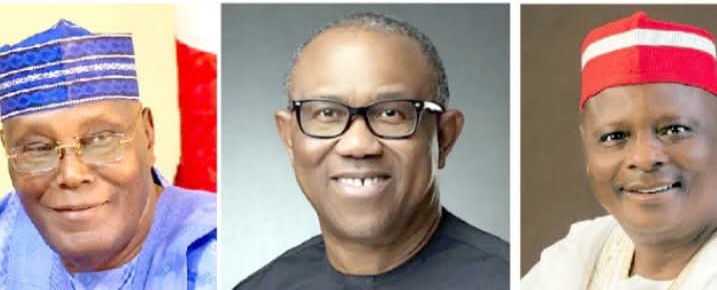
Fresh indications suggest that former presidential candidates Peter Obi and Rabiu Musa Kwankwaso may be exploring a joint presidential ticket ahead of Nigeria’s 2027 general elections, in what could become one of the most significant opposition realignments since 2015.
The proposed alliance is being discussed within the framework of a broader opposition coalition, with the African Democratic Congress (ADC) emerging as a potential platform. If it materialises, an Obi–Kwankwaso ticket would directly challenge former Vice President Atiku Abubakar, who is widely seen as the frontrunner for the ADC’s presidential ticket.
A Reunion After a Failed 2023 Alliance
Obi and Kwankwaso were the presidential candidates of the Labour Party (LP) and the New Nigeria People’s Party (NNPP) respectively in the 2023 elections. Both men explored the possibility of an alliance before that poll, but negotiations collapsed after disagreements over who would fly the ticket and who would serve as running mate.
Despite the failure, the 2023 election offered clear lessons. Obi secured over six million votes, winning the Federal Capital Territory, Lagos, and all five South-East states, while galvanising an unprecedented youth-led movement across Nigeria’s major cities. He finished third overall.
Kwankwaso, on the other hand, delivered a commanding victory in Kano State, one of Nigeria’s largest voting blocs, through his well-established Kwankwasiyya movement, finishing fourth nationally.
Obasanjo’s Role and Renewed Negotiations
According to multiple sources, the renewed push for unity is being quietly encouraged by former President Olusegun Obasanjo, who reportedly believes that a united Obi–Kwankwaso ticket offers the opposition its best chance of mounting a credible challenge to President Bola Ahmed Tinubu in 2027.
Sources claim Obasanjo has tentatively persuaded Kwankwaso to consider serving as Obi’s running mate. Obi formally joined the ADC in recent weeks and has publicly indicated his intention to contest in 2027.
Kwankwaso, who remains in the NNPP for now, told supporters over the weekend that he is holding consultations with political leaders and would soon announce his next move. One of his close aides confirmed that “high-level discussions with key stakeholders across the political spectrum” are ongoing.
Two Strategic Options on the Table
Insiders familiar with the talks say two main strategies are being considered.
The first is a direct contest for the ADC ticket, with Obi and Kwankwaso combining forces to challenge Atiku at the party’s primaries. Proponents of this plan believe that neither Obi nor Kwankwaso can defeat Atiku alone within the ADC’s internal power structure—but together, they may stand a chance.
The second option is a fallback plan: if securing the ADC ticket proves impossible, the duo could move to another political party to actualise the joint ticket.
Sources say this contingency reflects the recognition of Atiku’s entrenched influence within the ADC and the difficulty of dislodging him through party primaries alone.
Kwankwaso Sets Clear Conditions
Speaking to his supporters, Kwankwaso made it clear that any merger or coalition must come with a firm offer of either the presidential or vice-presidential slot.
“At the national level, our hope is to merge with others, whether under the NNPP or any other platform,” he said. “But those who want us must agree that I, Rabiu Musa Kwankwaso, will be number one or number two.”
He also dismissed reports linking him to a planned defection to the ruling All Progressives Congress (APC), insisting that his movement is national in scope and not limited to Kano State.
Analysts Weigh the Political Math
Political analysts say the renewed Obi–Kwankwaso talks reflect hard lessons from the fragmented opposition showing in 2023.
Prof. Abubakar Kari of the University of Abuja described the ticket as “mouthwatering,” noting Obi’s appeal among youths and urban voters and Kwankwaso’s dominance in the North, particularly Kano.
“If the two are able to pool their resources, it would be a very formidable ticket,” Kari said, while warning that Atiku’s presence on the ballot could complicate opposition calculations.
Similarly, Dr Sam Amadi of the Abuja School of Political and Social Thought said the ticket’s strength lies in its potential to combine southern urban support with northern grassroots mobilisation—but stressed that broader northern alliances would be crucial.
The Big Question for 2027
Ultimately, analysts agree on one point: the success or failure of an Obi–Kwankwaso ticket will depend on whether the opposition can avoid fragmentation.
If Atiku remains on the ballot and the opposition splinters once again, 2027 could mirror the outcome of 2023. But if the talks lead to genuine unity under a single platform, Nigeria’s political landscape could be heading for a fiercely competitive election circle.
