


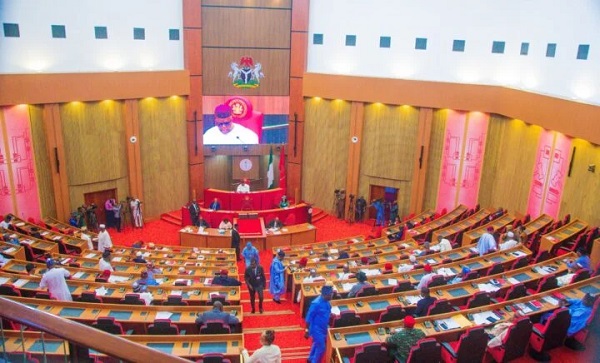
The Nigerian Senate has passed a constitutional amendment bill seeking to establish state police services across the country, in a move lawmakers described as a major step towards tackling the country’s worsening security crisis.
The bill was approved on Wednesday after senators considered and adopted its 26 clauses during the committee of the whole. The proposed legislation seeks to create a constitutional framework for state-controlled police services to operate alongside the existing federal police structure.
The measure is designed to improve intelligence gathering, strengthen local security responses and allow states to respond more quickly to threats such as kidnapping, banditry, communal violence and organised crime.
Leading debate on the bill, Senate Leader Opeyemi Bamidele said the proposal was an executive bill transmitted to the upper chamber by President Bola Tinubu.
He described the legislation as one of the most significant constitutional reforms since Nigeria’s return to democratic rule in 1999.
“This important bill seeks to alter the Constitution to provide for the establishment of State Police Services and other related matters,” Bamidele said on the Senate floor.
He argued that Nigeria’s current centralised policing system has come under severe pressure due to the scale and complexity of security threats across the federation.
According to Zebra News, the proposed amendment would preserve the Nigeria Police Force as a federal institution while creating a constitutional path for individual states to establish their own police services through laws passed by their respective state assemblies.
Under the bill, the federal police would continue to handle matters such as terrorism, organised crime, cybercrime, border security, arms trafficking and policing in the Federal Capital Territory.
State police services, on the other hand, would be responsible for enforcing state laws, maintaining public order, preventing and detecting crimes within their jurisdictions and protecting lives and property.
Bamidele said the legislation contains safeguards to prevent abuse of state police powers. He noted that governors would be barred from using state police to target political opponents, ethnic or religious groups, or individuals for personal or partisan purposes.
Several senators backed the proposal during debate, with some saying Nigeria’s worsening insecurity had forced a rethink of previous opposition to state policing.
Senator Enyinnaya Abaribe, who represents Abia South, said he had once opposed the idea but had now changed his position in light of the country’s security challenges.
“I used to be one of those against state police,” Abaribe said. “But today, we know that we have a very serious insecurity problem that can only be solved by thinking outside the box.”
He, however, warned that the eventual police legislation that would operationalise the amendment must contain strong safeguards to protect citizens’ rights and prevent federal overreach.
Abaribe also raised concerns over funding, saying allocations meant for state police commissions should be guaranteed and paid directly to them to avoid political interference.
Former Sokoto State governor and Senator Aminu Tambuwal also backed the bill, saying he had consistently supported state police as part of efforts to deepen federalism in Nigeria.
Tambuwal cited repeated attacks in Sokoto State as evidence that the country needed alternative security approaches beyond the present central system.
According to Zebra News, the passage of the bill marks a significant shift in Nigeria’s long-running debate over state policing, a proposal that has for years divided politicians, legal experts and civil society groups.
For the constitutional amendment to take effect, it must still secure the approval of at least two-thirds of the 36 state houses of assembly before it can be transmitted to President Tinubu for assent.a
