


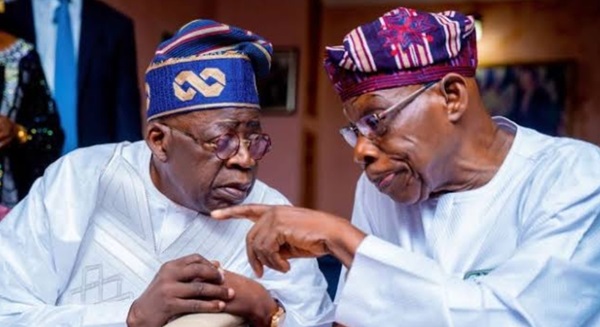
President Bola Tinubu has rejected former President Olusegun Obasanjo’s long-held view that Nigeria’s state-owned refineries may never become operational, insisting that the Port Harcourt, Warri and Kaduna refineries will return to productive use.
Tinubu made the remarks on Thursday while receiving the leadership of the Nigeria Union of Petroleum and Natural Gas Workers (NUPENG), led by its president, Salimon Oladiti, at the Presidential Villa in Abuja.
His comments mark one of his clearest public positions on the future of the government-owned refineries, which have remained largely dormant despite years of rehabilitation efforts and billions of dollars spent on maintenance and upgrades.
Addressing concerns about the facilities, the president said the refineries would resume operations but stressed that profitability, rather than visible activity, would determine their success.
“The refineries you mentioned are going to come back to work. We’re just building a very firm research and structural reworking of the economy of it. Ordinary flame and smoke of a refinery doesn’t mean it’s working, until it’s profitable and yields the value for which it is built,” Tinubu said.
The president added that he had accepted responsibility for the assets and liabilities inherited from previous administrations and was focused on ensuring the facilities become economically viable.
“I am not a man who looks back because I have accepted the asset and liability of my predecessor, no matter what has happened in the years past. It is my responsibility now to fix it and make it work for the largest common value of our population. I take responsibility for that, and I’m going to do it,” he stated.
Tinubu’s position contrasts sharply with that of Obasanjo, who has repeatedly argued that the Nigerian National Petroleum Company Limited (NNPC) lacks the capacity to successfully operate the refineries.
In a recent television interview, the former president said public-private partnerships offered a more sustainable model for managing major national assets and cited the Nigeria LNG project as an example of a successful arrangement.
Obasanjo recalled that during his administration he approached Shell to acquire a stake in, or manage, the refineries, but the company declined. According to him, Shell cited the small size of the plants, poor maintenance culture and corruption as key reasons for its decision.
He also revealed that businessman Aliko Dangote had offered $750 million for a 51 per cent stake in two of the refineries during his tenure, a transaction later reversed under the administration of the late President Umaru Musa Yar’Adua.
According to Obasanjo, he warned at the time that reversing the sale would eventually reduce the value of the facilities to little more than scrap.
The future of Nigeria’s state-owned refineries remains one of the most contentious issues in the country’s oil and gas sector.
Obasanjo has argued that more than $16 billion has been spent over the years attempting to rehabilitate the facilities without achieving sustainable results. Dangote has also questioned the viability of continued turnaround maintenance, comparing the process to trying to modernise a vehicle built decades ago.
Despite these concerns, Tinubu’s administration has maintained that the refineries can be revived. NNPC Group Chief Executive Officer Bayo Ojulari recently announced a memorandum of understanding with two Chinese firms aimed at rehabilitating the Port Harcourt and Warri refineries.
While stakeholders including oil marketers, manufacturers and private sector groups have called for the sale of the facilities, Tinubu’s latest comments indicate that his administration remains committed to restoring them to commercial operation.
The challenge for the government, however, will be proving that the refineries can move beyond rehabilitation promises and operate sustainably as profitable refining assets.
