


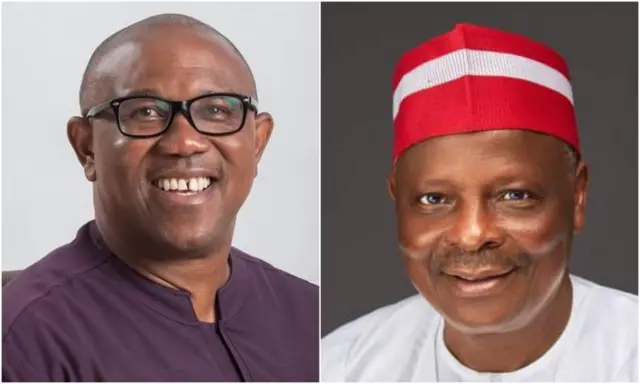
Vice-presidential candidate of the National Democratic Congress (NDC), Senator Rabiu Kwankwaso, has said his decision to become Peter Obi’s running mate in the 2027 presidential election was driven by national interest, equity, regional balance and the need for democratic change.
Kwankwaso, a former Kano State governor, disclosed this while featuring on the News Agency of Nigeria (NAN) Personality Interview Series in Abuja on Sunday.
He said his experience during the 2023 election had given him a better understanding of Obi and convinced him that they could work together to address Nigeria’s challenges.
“People learn every day and that is why experience is very important. In 2023, we attempted to work together and at that particular point, I knew little about Peter Obi.
“But over these last four years, I was able to learn a lot and realised that Peter is somebody that I could work together with,” he said.
Kwankwaso said the decision followed consultations with members of the Kwankwasiyya Movement, supporters of the New Nigeria Peoples Party (NNPP) and the Obidient Movement.
According to him, the groups agreed that Nigeria needed a balanced ticket capable of attracting support from both the North and South.
He said the arrangement was also influenced by the need for the South to retain the presidency for another term after the completion of the eight-year tenure of former President Muhammadu Buhari.
Kwankwaso said worsening insecurity, declining agricultural productivity, economic hardship and deteriorating infrastructure had strengthened his resolve to support an alliance capable of delivering political change.
He particularly highlighted the difficulties faced by farmers in Northern Nigeria, where insecurity and other economic challenges had made agricultural production increasingly difficult and unprofitable.
The former Defence Minister also criticised the state of infrastructure across the country, saying the situation underscored the need for the type of democratic change Nigerians sought in 2015.
He described the proposed Obi-Kwankwaso ticket as a combination of regional balance, competence and credibility.
“Nobody, no ticket can beat our own in terms of credibility, in terms of capacity and of course, in terms of love for the country; even in terms of empathy for the poor that are suffering across the country today,” he said.
Kwankwaso dismissed the suggestion that accepting the vice-presidential slot represented a setback, despite his previous positions as deputy speaker of the House of Representatives, governor, minister and senator.
“I have never been the vice-president. I think it is a step forward despite all the things you counted,” he said.
He maintained that his decision was not motivated by personal ambition, arguing that political office should primarily be viewed as an avenue to serve Nigerians.
“To me, being in government is to serve. I don’t have to be president. I don’t have to even be vice-president. These are things that are in the hands of Almighty Allah,” he said.
“But the fact remains that the situation, as it is today, one has to look at it beyond your humble self.”
The former governor said the agreement with Obi was for the South to produce the president for one term, after which the presidency would return to the North.
He cited historical examples of leaders who accepted positions below what they could have pursued, including Sir Ahmadu Bello, who chose to remain Premier of Northern Nigeria rather than become Prime Minister.
Kwankwaso said public service should not be defined by the particular office occupied, noting that leaders could contribute as councillors, local government chairmen, legislators, governors, ministers, vice-presidents or presidents.
He also rejected claims that his past engagements with the All Progressives Congress (APC) were based on demands for either the presidential or vice-presidential ticket.
According to him, discussions he held with President Bola Tinubu after the 2023 election focused on working together and were not linked to abandoning the NNPP or securing a political position.
Kwankwaso said he had played a significant role in the APC’s electoral victory, particularly through votes recorded in Kano in 2015, but later became disappointed with the party’s leadership.
He said his confidence in the Obi-Kwankwaso alliance had been reinforced by what he described as Obi’s commitment to fairness, justice and national unity.
Kwankwaso also expressed confidence that Obi would honour the one-term agreement and treat him as a partner rather than a “spare tyre”.
He said his experience as a deputy speaker, minister and governor had taught him the importance of giving deputies meaningful responsibilities.
The former governor said the proposed NDC administration would prioritise competence when appointing ministers and other officials, with positions allocated according to the country’s needs rather than political patronage.
“Power will be shared according to the needs of the country. We should not be in a hurry to go and take anybody on the streets or anybody we remember.
“We will make sure that we have competent people because from our experience, the president and vice-president cannot do it alone,” he said.
Kwankwaso added that an NDC government would require technocrats, professionals and experienced politicians capable of addressing Nigeria’s complex economic, security and developmental challenges.
