


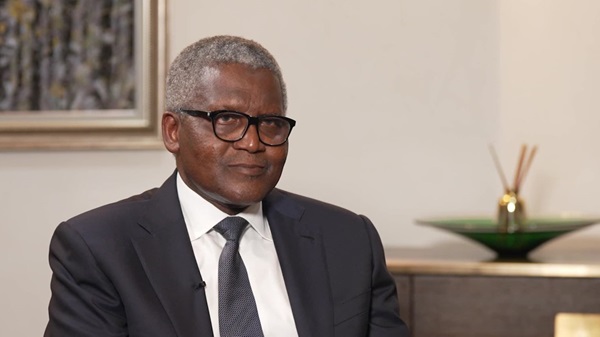
Africa’s richest man and President of the Dangote Group, Alhaji Aliko Dangote, has expressed serious doubts about the viability of Nigeria’s state-owned refineries in Port Harcourt, Warri, and Kaduna, describing efforts to revive them as futile despite massive investments exceeding $18 billion.
Dangote made the comments on Thursday while hosting members of the Global CEO Africa group from the Lagos Business School during a tour of the Dangote Petroleum Refinery in Lekki, Lagos.
The billionaire businessman questioned the continued expenditure on the Nigerian National Petroleum Company Limited (NNPC)-managed refineries, comparing the turnaround maintenance of the ageing facilities to modernising a 40-year-old car that can no longer withstand current technologies.
“Even if you change the engine, the body will not be able to take the shock of that new technology engine,” he said.
Dangote recounted how he and his team had acquired the refineries in 2007 under President Olusegun Obasanjo’s administration, only to return them months later following a change in government. He said former President Umaru Musa Yar’Adua reversed the sale after being advised that the refineries were undervalued and capable of functioning under NNPC management.
“As of today, they have spent about $18bn on those refineries, and they are still not working. I doubt very much if they ever will,” Dangote stated.
Obasanjo, Others Support Dangote’s View
Dangote’s remarks align with past comments by former President Olusegun Obasanjo, who has consistently criticised NNPC’s handling of the refineries. In 2024, Obasanjo said that despite declaring the facilities operational, NNPC quietly shut down the Port Harcourt and Warri refineries months later.
He said international oil firms, including Shell, had refused to take on management of the refineries during his presidency, citing inefficiencies and the risk of failure. Obasanjo also revealed that he sold the refineries to Dangote for $750 million, but his successor nullified the transaction.
“I told my successor that the refineries would not work, and when you want to sell them, you won’t get $200 million for them as scrap,” Obasanjo said.
“NNPC knew they could not operate them but kept spending because of the corruption within the system. In a civilised society, people would be in jail for that.”
Mounting Calls for Privatization
The debate over Nigeria’s state-owned refineries has intensified following their repeated shutdowns. The Port Harcourt refinery, briefly declared functional in Q4 2024, was shut again in mid-2025. The Warri refinery, declared operational in December, also ceased operations within a month.
Industry stakeholders, including the Manufacturers Association of Nigeria, have labelled the refineries a drain on public funds and urged the Federal Government to privatise them or sell them off as scrap.
Crude oil refiners and analysts have advised redirecting resources towards modular refineries, which are seen as more efficient and commercially viable.
Billions Spent, No Results
Despite persistent failures, successive governments have continued to allocate large sums to the refineries:
- $1.4 billion was approved in 2021 for Port Harcourt’s rehabilitation.
- $897 million and $586 million were earmarked for Warri and Kaduna refineries, respectively.
- In 2021 alone, N100 billion was spent, with N8.33 billion in monthly maintenance costs.
- Between 2013 and 2017, $396.33 million went to turnaround maintenance.
Yet, the facilities remain idle, producing no fuel.
Efforts to reach NNPC for comment were unsuccessful. The corporation currently has no designated spokesperson, and calls or messages to listed contact numbers went unanswered as of press time.
