


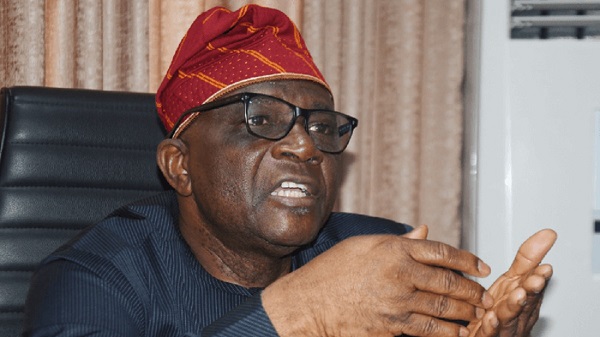
Bayo Onanuga, Special Adviser on Information and Strategy to President Bola Tinubu, has defended the administration’s economic reforms and policy direction, insisting that many Nigerians are already benefiting from government interventions despite persistent criticism over hardship and insecurity.
Speaking on Arise Television’s Prime Time programme on Tuesday, Onanuga rejected claims of widespread hunger across the country, arguing that such perceptions have been fuelled by narratives that gained traction shortly after President Tinubu assumed office.
“We have been pigeon-holed into certain assumptions and conclusions,” he said.
“It’s like in the early days of this government. Somebody did a voice-over saying that we are hungry. Since then, people have been saying that.
“I am a Nigerian; I have people working for me privately. I don’t see the level of hunger people are talking about because I see them and I keep asking them questions. How are things? How are they adjusting? What are the problems?”
Onanuga maintained that the impact of the administration’s policies is becoming increasingly visible, particularly through infrastructure projects being undertaken across the country.
He recounted a recent journey from Ibadan to Lagos, during which he discovered a newly constructed concrete road along the Ijebu-Ode route after diverting due to traffic congestion.
“One day, I was travelling from Ibadan to Lagos and Google Maps told me there was a go-slow as I approached Lagos. So, I decided to take Ijebu-Ode via Sagamu. What struck me was that I just found myself on a paved concrete road. I said, ‘wow, when was this one built?’” he said.
The presidential aide also highlighted the impact of the Lagos-Calabar Coastal Highway project, claiming it had significantly reduced travel time to his residence in Ajah.
“Anytime I go to Lagos and ask Google Maps to tell me how long it will take me to get home, it tells me one hour seven minutes,” he said.
“Before, it used to be two hours 30 minutes. The reason is because we now have a coastal road that has shortened my travel time.”
Zebra News reports that Onanuga also pointed to social intervention programmes such as the Nigerian Education Loan Fund (NELFUND) and the Nigerian Consumer Credit Corporation (CreditCorp) as evidence that the administration’s policies are delivering direct benefits to citizens.
“If you are a parent and you have four children in the university, and they are able to access a federal loan which is interest-free, are they not benefiting? If you are a civil servant and you can access CreditCorp, a very cheap loan at a single-digit interest rate, are they not benefiting?” he asked.
Addressing security concerns, Onanuga accused sections of the media of exaggerating the country’s security challenges and creating the impression that the entire nation is unsafe.
“The media in Nigeria are even creating the problem. The way they report insecurity is as if the entire country is consumed,” he said.
He cited a recent discussion with the Managing Director of NELFUND, who, according to him, travelled by road from Abuja to Kebbi State without encountering security threats.
“Don’t let people frighten you that the entire country is under siege. It is not so. There are security breaches, but the entire country is not under siege,” he added.
Onanuga also responded to recent comments by Peter Obi, presidential candidate of the Nigeria Democratic Congress (NDC), regarding electricity generation and supply in the country.
He argued that electricity generation had improved under the current administration and accused Obi of misunderstanding Nigeria’s installed generation capacity.
“Power generation has increased. We are not at the level the president met it. We already have in Nigeria a stored capacity of 13,500 megawatts,” he said.
According to Onanuga, one of the major constraints facing the power sector is inadequate gas supply, which he attributed to more than N4 trillion in legacy debts owed by operators to gas companies.
Zebra News understands that the remarks come amid ongoing public debate over the impact of the Tinubu administration’s economic reforms, including the removal of fuel subsidies and foreign exchange policy adjustments, which have drawn both praise and criticism from different segments of society.
